Tsum Valley Manaslu Trekking - 24 Days

Tripadvisor4.9(50 reviews)
Google4.9(57 reviews)

The Manaslu Tsum Valley Trek is a hidden gem in the Himalayas, offering trekkers an unforgettable journey through remote landscapes, rich cultural heritage, and breathtaking mountain views. Nestled in the northern part of the Manaslu region, the Tsum Valley remains largely untouched, preserving its ancient Tibetan culture, monasteries, and traditional villages. Along the trek, adventurers can experience serene forests, suspension bridges, high-altitude rivers, and panoramic views of towering peaks, including Manaslu. The region is also known for its friendly locals, unique festivals, and spiritual ambiance, making it a perfect destination for those seeking a blend of adventure and cultural immersion. Ideal for trekkers looking for solitude away from crowded trails, the Tsum Valley Trek promises a truly authentic Himalayan experience, combining natural beauty, cultural richness, and thrilling trekking challenges.

Trip Information
  • Duration24 Days
  • DestinationNepal
  • Difficulty Level Moderate to Difficult
  • Max Altitude5,106 m/16,752 ft
  • ActivityTrekking
  • Group Size1+
  • Trip StartKathmandu
  • Trip EndKathmandu
  • Best TimeMarch to May and Sept to Dec

Highlights of Tsum Valley Manaslu Trek

  • Adventure between massif  Mt. Manaslu  and  Ganesh Himal  mountain range.
  • Daily glorious views of unique landscapes of rolling green hills and high peaks..
  • On least explored areas to remote and isolated  Tsum valley  of happiness.
  • Explore impressive  Tsum  traditional culture of ancient heritage of Buddhism.
  • Trek to  Mu Gompa  the highest settlement of  Tsum areas  of great importance.
  • Walk from low warm areas to cooler alpine woodland to arid and barren terrain.
  • Follow  Buri-Gandaki River  to its glacial source on walks to high  Manaslu valley.
  • Great scenery of dramatic country on walks around  Manaslu  and  Tsum valley.
  • Crossing highest point of the adventure over  Larke-La  to reach at  Manang area.

Introduction: Tsum Valley Manaslu Trek

The Tsum Valley Manaslu Trek is a hidden Himalayan gem, offering an unparalleled journey through remote landscapes, ancient culture, and spiritual heritage. Located in the northern part of Gorkha District, Tsum Valley has long been referred to as the “Hidden Valley of Happiness”, a secluded region where traditional Tibetan-Buddhist culture thrives, untouched by mass tourism. Here, centuries-old monasteries, prayer flags, mani walls, and quiet villages create a spiritual ambiance that captivates every traveler.

This trek is part of the larger Manaslu Circuit, a route that showcases some of the highest and most dramatic Himalayan peaks. Trekkers are treated to awe-inspiring views of Mount Manaslu (8,163 m), Ganesh Himal, Himalchuli, and Shringi Himal, along with deep river valleys, cascading waterfalls, and lush forests. The trail meanders through traditional villages such as Chhokang Paro, Chumling, Nile, Tilije, and Deng, where the local people preserve centuries-old lifestyles, clothing, festivals, and customs.

The trek combines moderate to challenging trekking sections with experiences that are culturally enriching and spiritually uplifting. Crossing Larkya La Pass (5,160 m) provides an adrenaline-filled adventure and breathtaking panoramas, while the serene villages and monasteries of Tsum Valley offer moments of reflection and cultural connection.

Ideal for adventurers seeking solitude, photographers, nature enthusiasts, and cultural explorers, this trek offers a perfect balance of natural beauty, spiritual exploration, and Himalayan adventure. Every step along the Tsum Valley – Manaslu Trek immerses you in pristine landscapes, untouched wilderness, and a living Tibetan cultural heritage, making it one of the most rewarding off-the-beaten-path trekking experiences in Nepal.

Major Attractions on the Tsum Valley Manaslu Trekking

1. Tsum Valley – The “Hidden Valley of Happiness”

Tsum Valley is a remote Himalayan gem renowned for its traditional Tibetan culture and serene landscapes. Often called the “Hidden Valley of Happiness,” it has remained largely untouched by modern commercialization, offering trekkers a tranquil and authentic experience.

The valley is dotted with ancient monasteries, prayer flags, and spiritual sites, creating a deeply peaceful atmosphere. Its pristine nature, from lush forests to alpine meadows, enhances the feeling of walking through a timeless landscape.

Villages such as Chumling, Chhokang Paro, and Nile preserve centuries-old traditions, where local customs, lifestyle, and Tibetan-influenced architecture remain largely unchanged. Trekking through Tsum Valley is like stepping back in time, offering a rare glimpse into a living Himalayan culture.

2. Mu Gompa – The Largest Monastery in Tsum Valley

Mu Gompa is the largest and most significant monastery in Tsum Valley, serving as an important pilgrimage site for Tibetan Buddhists. Its spiritual importance and serene location make it a focal point of the valley’s religious life.

The monastery is beautifully surrounded by colorful prayer flags, intricately carved mani walls, and peaceful hills, creating a tranquil atmosphere perfect for meditation and reflection. Visiting Mu Gompa offers trekkers a unique opportunity to witness Tibetan Buddhist rituals, interact with monks, and experience the deep spiritual essence of this hidden Himalayan region.

3. Rachen Gompa – A Smaller, Ancient Monastery

Rachen Gompa is one of the older and smaller monasteries in Tsum Valley, yet it holds significant cultural and spiritual value. Its ancient architecture and sacred artifacts offer trekkers a glimpse into the valley’s rich Buddhist heritage.

The monastery’s serene setting amidst rolling hills and traditional villages makes it an excellent spot for cultural exploration and photography. Visiting Rachen Gompa allows you to observe local rituals, interact with monks, and capture the timeless beauty of Tsum Valley’s spiritual landscape.

4. Larkya La Pass – 5,160m

The Larkya La Pass is the highlight of the Manaslu Circuit Trek and the highest point of the journey, offering trekkers a true sense of achievement and adventure.

From the pass, you are rewarded with breathtaking panoramic views of towering peaks such as Manaslu, Himalchuli, and other majestic mountains that surround the valley. The dramatic landscapes, glaciers, and alpine ridges make it one of the most photogenic and memorable points of the trek.

Crossing Larkya La is not only a physical challenge but also an unforgettable Himalayan experience, combining the thrill of high-altitude trekking with the awe-inspiring beauty of Nepal’s rugged mountains.

5. Budhi Gandaki River Valley

The trek passes through the Budhi Gandaki River Valley, following the river for significant portions of the route. This valley is a scenic highlight, featuring crystal-clear river crossings, lush terraced fields, and forested trails that showcase the region’s natural beauty.

The combination of flowing waters, traditional villages, and surrounding mountains makes it an ideal spot for nature photography, offering countless opportunities to capture the tranquil and pristine Himalayan environment. Walking along the Budhi Gandaki River Valley allows trekkers to immerse themselves in nature while enjoying peaceful riverside landscapes far from the crowds.

6. Tibetan-Style Villages

Along the trek, you’ll pass through traditional Tibetan-style villages such as Chhokang Paro, Nile, and Tilje, where time seems to move slowly and life follows centuries-old customs.

These villages feature mud-brick houses, mani walls, colorful prayer flags, and other elements of Tibetan Buddhist culture, giving trekkers a vivid glimpse into local traditions. Staying in these villages also provides a chance to experience warm local hospitality, taste traditional foods, and interact with residents, making your journey not just a trek but a cultural immersion in the heart of the Himalayas.

7. Ganesh Himal & Himalchuli Views

Throughout the trek, you’ll enjoy spectacular views of iconic Himalayan peaks such as Ganesh Himal and Himalchuli, which rise majestically above the valleys. These mountains create a dramatic backdrop for the trail, enhancing every step of your journey.

The changing light at sunrise and sunset casts breathtaking colors on the peaks, making these moments perfect for photography and nature appreciation. Whether framed by forests, river valleys, or alpine meadows, the views of Ganesh Himal and Himalchuli are truly unforgettable, offering trekkers a continuous connection with the grandeur of the Himalayas.

8. Wildlife & Natural Beauty

The Tsum Valley Trek offers opportunities to experience the rich Himalayan wildlife and pristine natural landscapes. Trekkers may spot animals such as the Himalayan tahr, elusive red panda, langur monkeys, and a variety of bird species, adding an exciting element of discovery to the journey.

The trail winds through dense rhododendron forests, vibrant alpine meadows, and areas with snow-covered peaks, showcasing the incredible diversity of the region’s ecosystems. This combination of wildlife and breathtaking scenery makes the trek a paradise for nature lovers, photographers, and anyone seeking a deep connection with the Himalayan environment.

Why Choose the Manaslu Tsum Valley Trek?

1. Remote & Less Crowded

Unlike the popular Everest or Annapurna regions, this trek takes you far from the busy, commercialized trekking routes. The trails are peaceful and rarely crowded, allowing you to truly connect with nature and local culture without constant interruptions. You’ll walk through untouched landscapes, traditional villages, and serene forests where life moves at a slower, more authentic pace.

Because fewer trekkers visit this region, the experience feels more personal and immersive. You’ll have more meaningful interactions with local communities, enjoy quieter teahouses, and experience a sense of solitude that is increasingly rare in mainstream trekking destinations. This makes the trek ideal for travelers seeking tranquility, cultural depth, and a genuine Himalayan adventure away from the crowds.

2. Rich Tibetan & Buddhist Culture

Tsum Valley is widely known as the “Hidden Valley of Happiness,” a sacred Himalayan region deeply influenced by Tibetan Buddhism. The valley has remained culturally intact for centuries, allowing its traditions, beliefs, and daily lifestyle to be preserved in their original form.

Along the trail, you’ll encounter ancient monasteries such as Mu Gompa and Rachen Gompa, which serve as important spiritual centers for the local community. The path is lined with mani walls, chortens, prayer wheels, and colorful prayer flags, creating a deeply spiritual atmosphere throughout the journey.

The local people follow a Tibetan-influenced way of life, from their clothing and language to farming practices and religious rituals. Hospitality is simple and heartfelt, offering trekkers a rare glimpse into a culture that has changed very little over time. Walking through Tsum Valley truly feels like stepping into a living cultural museum, where history, spirituality, and everyday life blend seamlessly.

3. Stunning Himalayan Scenery

The trek offers breathtaking and constantly changing Himalayan landscapes that make every day feel unique. You’ll be rewarded with dramatic views of Mt. Manaslu (8,163m), the 8th highest mountain in the world, standing majestically above the surrounding valleys. Alongside Manaslu, stunning panoramas of Ganesh Himal, Himalchuli, and Shringi Himal dominate the skyline.

The trail takes you through deep river gorges, thundering waterfalls, lush forests, alpine meadows, and icy glaciers, showcasing the incredible diversity of the Himalayan terrain. As you gain altitude, the scenery transforms—from subtropical valleys to high-altitude landscapes dotted with snow-capped peaks.

Because the environment changes almost every day, the trek remains visually exciting and deeply rewarding, offering photographers and nature lovers endless moments of awe throughout the journey.

4. Sacred & Spiritual Journey

Tsum Valley is a deeply sacred Himalayan region, long revered as an important pilgrimage area for Buddhist practitioners. Traditionally declared a non-violence zone (Shyagya), the valley promotes compassion and respect for all living beings—values that are still practiced by the local community today.

Throughout the trek, you’ll feel a strong spiritual atmosphere, enhanced by ancient monasteries, meditation caves, prayer flags fluttering in the wind, and the soft hum of prayer wheels along the trail. Life here is guided by Buddhist philosophy, creating a sense of calm and reflection that naturally slows your pace.

This journey is ideal for travelers seeking more than just adventure. It is especially meaningful for those interested in mindfulness, Tibetan Buddhism, and authentic Himalayan traditions, offering a rare opportunity to reconnect with inner peace while walking through one of Nepal’s most spiritually significant valleys.

5. Adventure Without Extreme Difficulty

The Tsum Valley Trek offers a perfect balance between adventure and comfort. It is considered moderate to challenging, yet it does not involve any technical climbing or mountaineering skills, making it accessible to trekkers with reasonable fitness and some hiking experience.

The trail is ideal for those who want a true Himalayan adventure without choosing highly crowded or overly demanding routes. You’ll enjoy remote trails, suspension bridges, and varied terrain while still trekking at a manageable pace.

One of the key advantages of this trek is the gradual altitude gain, which allows proper acclimatization and reduces the risk of altitude-related discomfort. This makes the journey safer and more enjoyable, letting you focus on the scenery, culture, and overall experience rather than physical strain.

6. Combination of Culture + High Pass Adventure

This trek offers a rare and rewarding blend of deep cultural exploration and high Himalayan adventure. It uniquely combines the spiritual and cultural richness of the Tsum Valley with the dramatic landscapes and challenges of the Manaslu Circuit, creating a journey that is both meaningful and exhilarating.

One of the highlights of the trek is crossing the legendary Larkya La Pass (5,160m), one of the highest and most scenic trekking passes in Nepal. Reaching the top of the pass is a true achievement, rewarded with breathtaking panoramic views of snow-capped peaks, glaciers, and vast mountain valleys.

Very few trekking routes in Nepal offer such diversity in a single journey—ancient Buddhist culture, remote Himalayan villages, and a high-altitude mountain pass. This combination makes the trek ideal for travelers seeking a complete Himalayan experience that goes far beyond a standard trekking adventure.

7. Community-Based & Eco-Friendly Trek

The Tsum Valley Trek is not just an adventure—it’s a responsible and meaningful journey that directly benefits local communities. Most of the tea houses and lodges are run by local families, providing trekkers with authentic hospitality while supporting the livelihoods of the people living in these remote mountain villages.

The trek passes through the Manaslu Conservation Area, a protected region where environmental preservation is a priority. Sustainable trekking practices help minimize the ecological impact, keeping forests, rivers, and wildlife safe for future generations.

By choosing this trek, you contribute to the economic and social well-being of the local communities while enjoying an eco-friendly adventure. It’s an experience that allows you to connect deeply with both nature and culture, making your journey truly meaningful.

8. Ideal Alternative to Popular Treks

For trekkers seeking a fresh and unique Himalayan experience, the Tsum Valley Trek is the perfect choice. It’s an excellent alternative to the crowded Everest or Annapurna trails, offering a quieter and more intimate journey.

This trek is ideal for those who have already explored the major trekking routes and are looking for something different—an adventure that combines culture, solitude, and untouched natural beauty. Here, you can wander through remote villages, experience traditional Tibetan-Buddhist lifestyles, and soak in pristine landscapes without the crowds.

If you value authentic experiences, peaceful trails, and raw Himalayan scenery, this trek provides a rewarding and unforgettable escape from the usual tourist paths.

How does The Tsum valley Trek start and end

The Tsum Valley Trek is a journey that blends spiritual exploration, cultural immersion, and high Himalayan adventure. It begins in Kathmandu, Nepal’s bustling capital, where trekkers prepare by arranging permits, checking equipment, and attending a thorough briefing. This preparation ensures you are ready for the remote trails, high passes, and diverse terrains ahead.

From Kathmandu, the trek starts with a scenic road transfer to Soti Khola or Machha Khola, offering a first glimpse of the lush river valleys, terraced fields, and forested hills that define the lower Manaslu region. The trail then follows the Budhi Gandaki River, winding through traditional villages such as Jagat and Lokpa, where tea houses provide warm hospitality and the chance to meet local families.

As the trek progresses, you enter Tsum Valley, an isolated Himalayan region often called the “Hidden Valley of Happiness.” This area is a living museum of Tibetan culture, where centuries-old traditions remain intact. Villages like Chumling, Chhokang Paro, and Nile preserve ancient lifestyles, and trekkers encounter ancient monasteries such as Mu Gompa and Rachen Gompa, prayer flags fluttering along the trail, and mani walls marking sacred paths. The serene atmosphere and spiritual significance of Tsum Valley make it an ideal place for reflection and cultural immersion.

Beyond Tsum Valley, the trek transitions into the Manaslu Circuit, where the landscapes become more dramatic and alpine. Rolling hills give way to snow-capped peaks, glaciers, deep gorges, and alpine meadows. The trek reaches its climactic moment at Larkya La Pass (5,160 m), one of the highest trekking passes in Nepal, offering panoramic views of Manaslu, Himalchuli, and Ganesh Himal. Crossing this pass is both a physical challenge and a deeply rewarding experience, leaving trekkers with a lasting sense of accomplishment.

The descent from Larkya La passes through Deng, Namrung, Tilije, and Bhimtang, each village offering a glimpse into local culture and stunning scenic viewpoints. The trail gradually returns to lower altitudes, allowing for relaxation and reflection after the high-altitude adventure.

The trek concludes at Dharapani, where trekkers are transported back to Kathmandu, completing a journey that encompasses remote Himalayan landscapes, rich Tibetan-Buddhist culture, thrilling mountain adventures, and unforgettable natural beauty. The Tsum Valley – Manaslu Trek is not just a trek—it’s an immersive Himalayan experience that combines serenity, adventure, and cultural richness in one extraordinary journey.

Outline Tsum Valley Trek Itinerary

Day 01: Arrival in Kathmandu and transfer to Hotel.

Day 02: In Kathmandu sightseeing tour at places of interest.

Day 03: Drive to Soti Khola via Arughat journey.

Day 04: Trek to Machha Khola 

Day 05: Trek to Jagat via Dovan Zand Tatopani (Hot Spring) 

Day 06: Trek to Lakuwa 

Day 07: Trek to Chumling 

Day 08: Trek to Chhokangparo 

Day 09: Trek to Nele after a visiting Milarepa cave 

Day 10: Trek to Mu Gompa

Day 11: Rest day at Mu Gompa visit local village and monastery.

Day 12: Trek to Rachen Gompa

Day 13: Trek back to Chumling

Day 14: Trek to Lakuwa

Day 15: Trek to Ghap

Day 16: Trek to Lo-Gaon

Day 17: Trek to Sama-Gaon

Day 18: Trek to Samdo

Day 19: Trek to Dharamsala / Larke Phedi

Day 20: Cross Larke-la and descen to Bimthang

Day 21: Trek to Gho

Day 22: Trek to Dharapani

Day 23: Drive to Kathmandu via Besisar / Lamjung

Day 24: Final International departure from Nepal.

We can customize the Tsum Valley Trek Itinerary to suit your needs, whether you prefer a relaxed pace with extra time in villages, additional sightseeing stops, or more challenging trekking days. Every journey can be tailored to match your interests, fitness level, and schedule, ensuring a personalized Himalayan experience that’s both enjoyable and memorable.
Itinerary
Expand AllCollapse All

On arrival at Kathmandu international airport via respective airlines, where you will be received by our office staff and guide with warm welcome greeting and then transfer to your hotels in the hub of the city. After checking into your rooms and getting refreshed join the other groups of Tsum Valley and Manaslu Adventures at meeting hall for briefing, where our guide offers useful information regarding trek and your stay in Nepal with us. Evening includes welcome dinner in a nice and authentic Nepalese restaurant with Folk Culture program of Nepal while having your dinner.

    Morning depart for tour around Kathmandu at places of interest, as Kathmandu valley is steeped with historical and religious monuments temples and monasteries full of World Heritage Sites.

    • Kathmandu Durbar Square
    • Pashupatinath Temple
    • Bouddhanath Stupa
    • Swyambhunath stupa

    After an interesting tour afternoon free to relax and preparation for Tsum Valley and Manaslu Adventure next early morning overland drive to Gorkha area.

      Morning transfer for exciting overland drive towards Mid-West on Nepal's busy and main highway as the journey leads to lower warmer mid hills past farm villages and towns with views of snowcapped peaks. As the drive continues with few refreshing stops heading west to reach at Dhading and towards Gorkha areas to reach at warm sub-tropical in Arughat by the raging Burigandaki River, and then drive continues on dirt road past farm villages and terraced fields to reach at Soti Khola, for overnight stop with time to relax and stroll around this small farm village.

        Frist day walks begins from Soti-khola, where trail cuts into steep valley, within densely forested areas and through number of small villages tucked in a hillside, then reaching a wide valley opposite at the point where large tributary stream enters into Burhigandaki River. The terraced cultivated field belongs to upper village of Lapbesi. From here our path descends to a wide, sandy riverbed following a trail meandering below the steep, craggy valley side. At some length leading to a climb on the trail to Machha Khola for overnight stop, with number of teashops and small lodge, the word Maccha Khola means Fish Stream.

          The trail from this small village leads into interesting farm villages and fields as the vegetation changes slowly, starting morning walk crossing a stream that names Machha Khola (Fish stream), and then heading upstream towards Khola-Bensi village and at Tatopani 'hot spring'.

          An opportunity for hot bathe as time allows, after a nice break walk carries on passing Dovan and Yaruphant villages to reach at Jagat for overnight stops, Jagat a moderate size farm villages with shops and stores.

            From Jagat, morning walk leads to higher areas passing scattered farm villages with short climb and downhill to cross over a bridge to reach at Nagjet and Philim, a large village with spread-out farm houses. After Philim walk through farm terraces of golden fields of wheat’s and barley, then a climb on rocky ridge top into bamboo forest area to our overnight stop at Lakuwa on leaving the main trail of Manaslu route.

              After Lokpa village, walk heads to our first highlights of the adventure at Tsum known as the valley of happiness, as our route enters narrow gorge then with short descend and uphill climb into rhododendron and pine tree forest walking past small farm villages then climbing above Lungwa Khola to reach at Chumling village for first night stop around Tsum Valley.

                From here gaining altitude slowly within the massive peaks of Ganesh Himal peaks towards east and Manaslu in the western direction, as the walk proceeds where villages and landscapes changes similar to Tibetan windswept plateau.

                Morning walks leads on downhill path to cross a bridge over Smatiking Khola, with views of Ganesh Himal also known as Yangra at 7,422 m high, and then reaching at Chokhanparo village for overnight stop.

                  After a pleasant overnight stop at Chokanparo, our route leads towards upper Tsum area at Nele (Ne-lay), starting with uphill onto wide open valley around windswept terrain with only few small trees of juniper and willow that survives around this rough and arid country. Walk continues uphill with views of Ganesh and Manaslu Himal, after a wonderful and scenic walk reaching at Nele for overnight stop, on route Nele with time to visit an old holy mediation cave of 11th Centaury Saint Milarepa, famous and popular among Buddhist as poet, singer, tantric guru his folk-tales and songs are still remembered by Tibetans and Buddhist followers.

                    Today walk leads to main highlight and the highest point of the adventure at Mu Gompa, as walk continues climbing high within arid terrain offering views of high peaks on the way to Mu Gompa for overnight stop.

                      At Mu Gompa free and rest day to explore the unexplored areas around high valley of Tsum with its traditional villages and interesting old Mu Gompa with ancient antique idols and scrolls, statue and relics this is one of the most important monastery of Tsum and Manaslu area. The village of upper Tsum located on route Tibet border, which is least frequented by foreign trekkers and adventurer, here enjoy the scenery and culture in complete natural surroundings.

                        After marvelous time at Mu Gompa, return journey leads to another impressive monastery at Rachen Gompa, walk on nice trails with some short climbs and downs passing few small scattered farm villages of cattle herders to reach at Rachen Gompa for overnight stop, afternoon visit Rachen monastery which treasures historical and religious artifacts and important statues of famous Gurus with idol of Sakaymuni Buddha.

                          Today our last day around Tsum valley, as the morning walk leads to a long descend to Chumling village passing farm areas and then back into tree lines, after a long downhill walk of 6 hours reaching at Chumling village for last overnight stop around Tsum.

                            After completing our first phase of the journey, from here on leaving behind beautiful Tsum areas heading towards high Manaslu valley where walk first leads back at Lakuwa before joining the trail of Manaslu route.

                              After a pleasant stop at Lakuwa morning walk lead with slow rise in elevation, as walk enters within Himalayan high areas, with some short downhill to river side to reach Bihi Bazaar a small village by the river. From here on where you will soak into more Tibetan culture of Buddhist religion, as our walk continues on gradual path with few short ups and downs to reach at Ghap village for overnight stop.

                                From Ghap village walking along Budhi Gandaki River, after a short walk cross the river towards small farm villages at Numrung village with closest views of  Mt. Manaslu North Face includes its range of peaks.Our journey continues past villages of Banjham, Lhi and Sho, as altitude gains to reach with an hour up to Lo-Gaon for overnight stop.

                                  Today’s walk leads to main large village of upper Manaslu at Sama-Gaon where tree lines disappears for short juniper bushes with some willow trees, morning walk follows a nice trail with views of Manaslu peaks, as walk proceeds to end the day at Sama-Gaon for overnight stop, one of the largest villages of upper Gorkha district which lies route Manaslu base camp. Here with time to explore around village of great interest adorned with Tibetan Buddhist religion and culture, a short walk up to Sama Gompa above the village one of the major Nyligpa (red hat sect) Monastery of the region.

                                    Today walk leads to remote and last village of Manaslu area of Upper Gorkha region, where Samdo lies close on route to Tibet border, the native of the area have long history trading with Tibet, the trade continues till present. As walk leads with slow up with fabulous views of peaks and then reaching at Samdo village, a moderate size village with shops and stores selling many Chinese goods.

                                      From Samdu enjoy half day walk to Larke Phedi means bottom of the hill or pass also called Dharmasala, after overnight at Samdo village, morning walk heading into dry and barren country. As altitude gains walking on trail that leads to few short ups and downs then completing the day walk on reaching at Larke Phedi, with afternoon free at leisure and preparation for the next day early climb over highest point of the adventure Larke-La at 5,106 m high

                                        One of the longest and big days of the adventure, start with early breakfast and then heading to a slow climb to reach on top Larke-la pass, as walk progress encountering a steep path rewarded with fabulous views of Mt. Manaslu, Larke peak, Bouddha Himal, Himal-Chuli and Peak 29.

                                        After a strenuous climb on reaching the pass, the top marked with Buddhist prayer flags and cairns of stones, enjoy the super views of great giant peaks, after a refreshing break, a long descend to reach at Bimthang for overnight stop.

                                        Bimthang located on beautiful green valley surrounded with tall rhododendron and pines trees, enjoy the afternoon with rest after the longest walk of the adventure.

                                          After a tough long walk of previous day, from here on an easy trek with much descend into forested areas all the way to Gho, located in the middle of enchanting forest.

                                            From this small settlement in the middle of the woods at Gho, morning walk leads downhill all the way to reach at Telje village located by the Masrsyangdi River, after a rest at Tilje, continue our last day walk of the adventure with last final climb to reach at Dharapani for overnight stop in a nice lodge. Dharapani a large village with many fine lodges located in Manang district and on popular Annapurna Circuit trekking trail.

                                              Ending our adventurous and scenic Tsum Valley and Manaslu Adventure at Dharapani, morning drive leads into several farm villages following Marysangdi River downstream reaching low and warmer areas, past Tal, Chamje and another Jagat village, as drive leads continues on good road to large town at Besisar, headquarter of Lamjung district.From Besisar with time for rest and possible lunch stop, continue drive back to Kathmandu on good road, on reaching Kathmandu check into your hotels with rest of the evening free at leisure with last day in Nepal.

                                                Your last day in amazing Nepal, the land of Himalayan wonders as per your international flight time back home or to respective connecting destinations. Our staff and guide transfer you to Kathmandu airport after a mesmerizing time on Tsum Valley and Manaslu Adventure

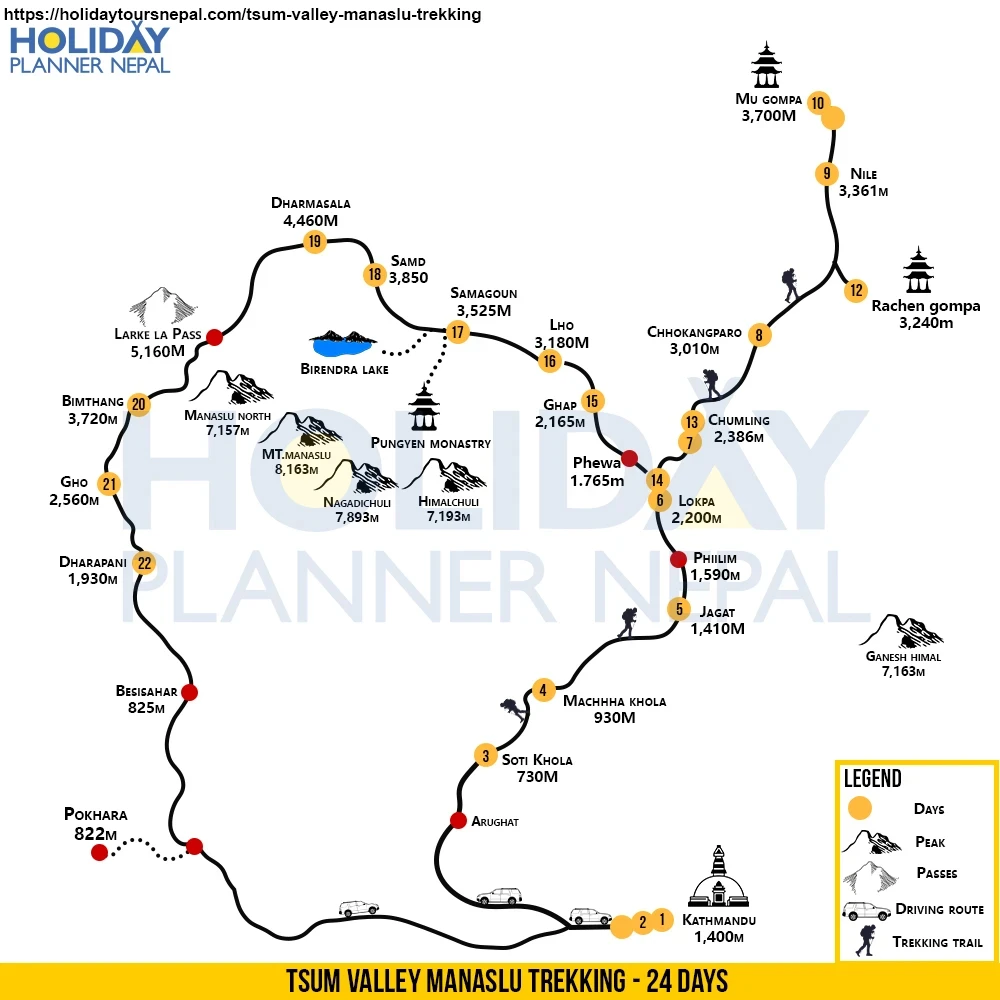
                                                  Route Map

                                                  Tsum Valley Manaslu Trekking - 24 Days map
                                                  Cost Details
                                                  What's Included
                                                  • All airport pick-up and drop-off by private vehicle
                                                  • 03 nights twin/double shearing deluxe accommodation on BB in Kathmandu
                                                  • Guided sightseeing tours with private vehicle in Kathmandu
                                                  • Kathmandu to Arughat and Bhulbule to Kathmandu public transport (if you want both ways, private vehicles are also available at an additional cost).
                                                  • Annapurna Conservation Area Permit, Manaslu Conservation Area Permit and Special permit for Manaslu and Tsum Valley Area
                                                  • Twin/double shearing accommodation in the mountain during the trekking
                                                  • Three meals a day; breakfast, Lunch and dinner, and tea/coffee during the trekking
                                                  • A highly experienced, helpful, knowledgeable, friendly , English-speaking, well trained, Government licence holder guide with all his salary, food, drinks, accommodation, Transport and insurance.
                                                  • 02 guests = 01 porter with their Insurance, Salary, Food, accommodation and equipment
                                                  • We provide an assistant guide his salary, food, drinks, accommodation, transport and insurance, walking with group to support where necessary as per the group size
                                                  • Safe drinking water 
                                                  • All applicable government and local taxes per the itinerary
                                                  What's not Included
                                                  • Nepal Visa fee (Bring accurate fee in USD and two passport-size Photo)
                                                  • International airfare to and from Kathmandu (no need to pay departure tax for international flight)
                                                  • Diner and lunch in Kathmandu
                                                  • Personal travel and health insurance; Insurance for helicopter evacuation
                                                  • Extra night accommodation and lunch and dinner in city because of early arrival, late departure or early return from the mountain (due to any reason), then the scheduled itinerary
                                                  • Personal expenses (phone calls, baggage charge, laundry, bar bills, battery recharge, extra porters, bottle or boiled water, shower, etc)
                                                  • Tips to the trekking crews and drivers
                                                  • Extra expenses due to flight delays, strikes, weather conditionsor any event out of our control
                                                  • Anything not included in service includes column
                                                  Availability
                                                  • The trip departs everyday if the year
                                                  • The trip and trek is fully customizable we can customize the trip according to the need and necessity of our clients

                                                  • The trip is available for solo travelers group travelers and private travelers

                                                  • We organize the trip for a large group and can provide service for a group of 100+ members as well

                                                  • If the given date are not appropriate for the travllers and trekkers the trip can be conducted on the custom date provided by our clients

                                                  • Holiday tours Nepal advises all our clients to book at least 7 days prior so all the arrangements can be done in time specially sometimes in themountains the accommodation are booked prior so prior booking helps a lot

                                                  Contact us at [email protected] or send us a text at +977-9816710843 or +977-9818178630 we are available 24/7 on whatsapp viber wechat for additional informations.

                                                  Useful Information

                                                  Manaslu Trekking Permit Cost

                                                  The Manaslu Tsum Valley Trek falls within the Manaslu Conservation Area, a protected region in northern Nepal. To preserve its unique natural and cultural heritage, the Nepalese government requires trekkers to obtain several permits before entering the area. These permits ensure regulated tourism, support local communities, and help maintain the fragile ecosystem.

                                                  The following documents and licenses are required for the Tsum Valley trek:

                                                  TIMS (Trekkers Information Management System)

                                                  • Cost: Around USD 20 for individual trekkers, USD 10 for groups.

                                                  • Validity: During the trek duration.

                                                  • Purpose: Mandatory registration for all trekkers in Nepal. Helps authorities track trekkers and ensures safety in remote areas.

                                                  Manaslu Conversation Area Permit (MCAP)

                                                  • Cost: Approximately USD 70 for 8–15 days, additional USD 10 per extra day.

                                                  • Validity: Duration of your stay in the Manaslu Conservation Area.

                                                  • Purpose: Required to enter the Manaslu Conservation Area. Fees support conservation projects and local development.

                                                  Tsum Valley Special Permit

                                                  • Cost: Around USD 30–40 per person.

                                                  • Validity: Usually matches the trekking period.

                                                  • Purpose: Protects the sacred and culturally sensitive Tsum Valley. Helps regulate visitor access and preserve local traditions.

                                                  Manaslu Restricted Area Permit

                                                  • Cost: Approximately USD 50–70 per person.

                                                  • Validity: Matches the trekking duration.

                                                  • Purpose: Allows entry to the restricted zones of Manaslu. Ensures compliance with government regulations and environmental protection.

                                                  Note: The Manaslu Tsum Valley permit cost is included in the package, so visitors who wish to embark on the trek do not need to pay an additional amount for the permits.

                                                  Best seasons for Manaslu Tsum Valley trekking

                                                  1. Spring (March – May)

                                                  • Weather: Daytime temperatures are generally mild (10–20°C at lower altitudes), though higher altitudes can still be chilly. Skies are mostly clear, and the probability of rain is low.

                                                  • Scenery: This is when the rhododendrons bloom, painting the hillsides in bright red, pink, and white colors. Birds and wildlife are more active, making it a perfect time for nature lovers and photographers.

                                                  • Trail conditions: Snow on lower-altitude trails has mostly melted, making trekking easier. Some higher passes may still have patches of snow, so proper gear is recommended.

                                                  • Cultural highlights: Local festivals such as Buddhist celebrations in the Tsum Valley villages often take place in spring, offering insight into local traditions.

                                                  2. Autumn (September – November)

                                                  • Weather: This is the most popular trekking season. Skies are clear and stable, with daytime temperatures ranging from 15–25°C at lower elevations. Rainfall is minimal after the monsoon.

                                                  • Scenery: Snow-capped peaks, including Manaslu (8,163 m), Ganesh Himal, and Annapurna range, are visible in crystal-clear conditions. The valley landscapes are golden and vibrant after the monsoon.

                                                  • Trail conditions: Trails are dry and easier to navigate. The post-monsoon freshness ensures fewer landslides compared to the rainy season.

                                                  • Photography: Perfect lighting and clear skies make autumn ideal for stunning photographs of mountains, rivers, and villages.

                                                   Accommodation and Food option during Manaslu Tsum Valley Trek

                                                  The Manaslu Tsum Valley is a remote trekking region, so accommodations are basic but comfortable enough for trekkers.

                                                  Types of accommodation:

                                                  1. Tea Houses / Lodges

                                                    • Most common along the trail.

                                                    • Usually small, family-run, providing simple rooms.

                                                    • Rooms: Often dormitory style or private rooms with basic beds, blankets, and sometimes a heater in higher altitudes.

                                                    • Bathrooms: Shared; hot showers may be available for extra cost (~$2–3 USD).

                                                    • Availability: Rooms are limited in remote villages, so it’s better to arrive early.

                                                  2. Camping

                                                    • Some trekkers or trekking groups opt for tent camping, especially in very remote areas.

                                                    • Requires arranging with a guide/trekking company for tents and meals.

                                                  Tips for Accommodation

                                                  • Carry a sleeping bag (rated for cold weather), especially for nights above 3,500 m.

                                                  • Tea houses are more basic in smaller villages like Chumling, Chhekampar, or Chhokangparo.

                                                  • During peak trekking season, it’s advisable to book through a guide to secure rooms.

                                                  Is Travel insurance required for Tsum Valley Trekking?

                                                  Travel insurance is mandatory for the Manaslu Tsum Valley Trekking. It is optional, however, as the Tsum Valley Route is challenging due to physical factors and various other factors. So, travel insurance can ease the experience in any unforeseen circumstances. Some of the advantages of having Travel insurance are as follows:

                                                  Travel insurance helps to cover any accidental injuries which can occur during the trek.

                                                  It can cover emergency evacuation costs or any medical emergencies. However, an individual must purchase this particular policy to claim it. Read all the details, as the procedure may vary according to the altitude.

                                                  • It can help compensate for lost, stolen, or delayed baggage.
                                                  • It helps compensate for delayed, canceled, or emergency transportation trips.
                                                  • Suppose valuable documents like a passport, visa, or other travel documents are lost. In that case, insurance can help make up for it.
                                                  • If an individual is liable for any damage of property or legal expenses during the trip can be covered by insurance.
                                                  • Helps indirectly assist you with financial protection, giving you peace of mind.

                                                  Note: Holiday Planner Nepal does not provide travel insurance. To get travel insurance, you must buy them individually from an insurance company. Similarly, buy the policy that covers all the points mentioned above and read them carefully, as they are different for different altitude trekking.

                                                  Altitude and Distance Coverage of Tsum Valley Manaslu Trekking

                                                  Day 

                                                  Activity 

                                                  Altitude (m/ft) 

                                                  Distance (km/mi) 

                                                  Duration 

                                                  Elevation Gain/Loss (m/ft) 

                                                  Day 01 

                                                  Arrival in Kathmandu 

                                                  1350 m / 4429 ft 

                                                  Day 02 

                                                  Drive to Soti Khola 

                                                  710 m / 2329 ft 

                                                  ~140 km / 87 mi 

                                                  ~7-8 hrs 

                                                  Day 03 

                                                  Trek to Machha Khola 

                                                  900 m / 2953 ft 

                                                  ~14 km / 8.7 mi 

                                                  5-6 hrs 

                                                  +190 m / +624 ft 

                                                  Day 04 

                                                  Trek to Jagat 

                                                  1410 m / 4626 ft 

                                                  ~22 km / 13.7 mi 

                                                  6-7 hrs 

                                                  +510 m / +1673 ft 

                                                  Day 05 

                                                  Trek to Lokpa 

                                                  2240 m / 7349 ft 

                                                  ~16 km / 10 mi 

                                                  6-7 hrs 

                                                  +830 m / +2723 ft 

                                                  Day 06 

                                                  Trek to Chumling 

                                                  2386 m / 7828 ft 

                                                  ~10 km / 6.2 mi 

                                                  5-6 hrs 

                                                  +146 m / +479 ft 

                                                  Day 07 

                                                  Trek to Chhokang Paro 

                                                  3031 m / 9944 ft 

                                                  ~13 km / 8.1 mi 

                                                  6-7 hrs 

                                                  +645 m / +2116 ft 

                                                  Day 08 

                                                  Trek to Nile/Chhule 

                                                  3361 m / 11,027 ft 

                                                  ~11 km / 6.8 mi 

                                                  5-6 hrs 

                                                  +330 m / +1083 ft 

                                                  Day 09 

                                                  Trek to Mu Gompa, explore, return to Nile 

                                                  3700 m / 12,139 ft 

                                                  ~10 km / 6.2 mi 

                                                  4-5 hrs 

                                                  +339 m / +1112 ft (gain/loss) 

                                                  Day 10 

                                                  Trek to Rachen Gompa 

                                                  3240 m / 10,630 ft 

                                                  ~12 km / 7.5 mi 

                                                  5-6 hrs 

                                                  -460 m / -1509 ft 

                                                  Day 11 

                                                  Trek to Dumje 

                                                  2440 m / 8005 ft 

                                                  ~15 km / 9.3 mi 

                                                  5-6 hrs 

                                                  -800 m / -2625 ft 

                                                  Day 12 

                                                  Trek to Namrung 

                                                  2630 m / 8629 ft 

                                                  ~19 km / 11.8 mi 

                                                  6-7 hrs 

                                                  +190 m / +623 ft 

                                                  Day 13 

                                                  Trek to Samagaun 

                                                  3530 m / 11,581 ft 

                                                  ~17 km / 10.6 mi 

                                                  6-7 hrs 

                                                  +900 m / +2953 ft 

                                                  Day 14 

                                                  Acclimatization day in Samagaun 

                                                  3530 m / 11,581 ft 

                                                  Optional hikes 

                                                  Day 15 

                                                  Trek to Samdo 

                                                  3860 m / 12,664 ft 

                                                  ~8 km / 5 mi 

                                                  3-4 hrs 

                                                  +330 m / +1083 ft 

                                                  Day 16 

                                                  Trek to Dharamsala (Larke Phedi) 

                                                  4460 m / 14,633 ft 

                                                  ~12 km / 7.5 mi 

                                                  4-5 hrs 

                                                  +600 m / +1969 ft 

                                                  Day 17 

                                                  Cross Larke La Pass, trek to Bhimthang 

                                                  5160 m / 16,929 ft (pass), 3590 m / 11,778 ft 

                                                  ~24 km / 14.9 mi 

                                                  7-9 hrs 

                                                  +700 m / +2296 ft (gain), -1570 m / -5151 ft (loss) 

                                                  Day 18 

                                                  Trek to Tilije 

                                                  2300 m / 7546 ft 

                                                  ~19 km / 11.8 mi 

                                                  5-6 hrs 

                                                  -1290 m / -4232 ft 

                                                  Day 19 

                                                  Trek to Dharapani, drive to Besisahar 

                                                  760 m / 2493 ft 

                                                  ~24 km / 14.9 mi 

                                                  5-6 hrs (trek), ~4 hrs (drive) 

                                                  -1540 m / -5052 ft 

                                                  Day 20 

                                                  Drive back to Kathmandu 

                                                  1350 m / 4429 ft 

                                                  ~172 km / 107 mi 

                                                  ~8-9 hrs 

                                                  +590 m / +1936 ft 

                                                  Day 21 

                                                  Rest or free day in Kathmandu 

                                                  1350 m / 4429 ft 

                                                  Day 22 

                                                  Cultural sightseeing in Kathmandu Valley 

                                                  1350 m / 4429 ft 

                                                  Half-day tours 

                                                  Day 23 

                                                  Extra buffer day 

                                                  1350 m / 4429 ft 

                                                  Day 24 

                                                  Final departure 

                                                  1350 m / 4429 ft 

                                                  Tips for trekkers who are trekking in the Himalayas

                                                  • Build stamina, practice hiking and do some hikes that involves altitude to know how your body would react in high altitude.

                                                  • Let the loved ones know that you’re traveling to your family or loved ones and let them know about the agency that you’re traveling with.
                                                  • Stay connected, share your itinerary, respect local customs and be honest with the guide and let them know if you’re not feeling well
                                                  • Stay hydrated and nourished in the mountains and remember food is fuel if you stop consuming food remember your going to fall sick or lose energy so don’t stop eating.
                                                  • Be patient stay positive and trust your instincts and remember in altitude sometimes you feel angry and can have secondary thoughts.
                                                  • Check the weather forecast or ask the guide about the weather and what to wear.
                                                  • Respect local traditions, leave no trace, use eco friendly products and keep the trails clean.
                                                  • Keep the money, document and important documents safe
                                                  • Keep the power bank, cameras and electronics safe and at night try to cover the electronics with clothes so they stay warm and don’t drain the battery.

                                                  Tips for female travelers during periods in the mountains

                                                  • Know your cycle and pack accordingly sanitary pads, period underwear’s, menstrual cups and tampons.

                                                  • Pack sanitary pads in case sometimes the dates can be up and down and even someone might need in trek in case you don’t use it.

                                                  • Bring pain relivers like ibuprofen, heat patches, to ease cramps stay hydrated and eat good nutrition food.

                                                  • Wear comfortable and food layered clothing’s rest when needed and mind your mood.

                                                  Gearlist for Tsum Valley Trek

                                                  GeneralGeneral

                                                  • Four-season (-20 degree) sleeping bag (We provide rental sleeping bags available for an additional USD 35)
                                                  • Puffy down jacket (We provide rental jackets for an additional USD 35)
                                                  • Daypack (25-30 liters recommended) with rain cover

                                                  CatUpper Body

                                                  • Sun hat or cap (We'll provide you with a trekking cap.)
                                                  • Warm woolen hat
                                                  • Scarf/Neck Buff (highly recommended to get saved from wind and cold)
                                                  • Headlamp or mobile torch light for nighttime
                                                  • Polarized sunglasses

                                                  TorsoTorso

                                                  • Technical fabric base layer thermals are light for warmer months, heavy for colder months
                                                  • Technical fabric t-shirts and sleeve sweaters or high-necks
                                                  • Waterproof rain jacket
                                                  • Windproof jacket for the walk as it gets windy
                                                  • Fleece jacket or down jacket

                                                  LowerLower Body

                                                  • Thermals inner
                                                  • Hiking pants at least 3
                                                  • Comfortable pants for teahouses
                                                  • Waterproof, windproof shell
                                                  • Hiking shorts

                                                  glovesHands

                                                  • Woolen gloves for the tea house
                                                  • Hard-shell windproof outer gloves for the walk

                                                  feetFeet

                                                  • Marino Wool or comfortable, warm socks
                                                  • Hiking socks
                                                  • Liner socks
                                                  • Trekking/hiking boots (waterproof recommended)
                                                  • Crampons (For passes)
                                                  • Casual shoes or sandals that are comfortable for the time in the tea house
                                                  • Gaiters (lightweight for rain and snow)

                                                  undergarmentUndergarments and Inner Wears

                                                  • Technical fabric/quick drying (can be washed during the trek)
                                                  • Sports bras (women)
                                                  • Sleeping clothes as per the comfortability

                                                  FirstaidFirst Aid Kits and Medications

                                                  • Sunscreen SPF- 50+
                                                  • Lip balm or Vaseline
                                                  • ointment cream
                                                  • Cough Syrup and strepsils (recommended for Khumbu Cough)
                                                  • Creams and medicines (for any allergies or diseases)

                                                  Note: Our guides carry medications, oxygen cans, and first aid kits during the trip. However, personal kits and medications are recommended.) 

                                                  Optional Other Essentials

                                                  • Passport
                                                  • Extra copies of passport-sized photos
                                                  • Reusable water bottle
                                                  • Toilet paper, small soap, and shampoo
                                                  • Water purification tablets or UV water purifier (if you plan to treat water)
                                                  • Water bladder for the day bag
                                                  • Small towel for personal use
                                                  • Pillowcase in case of allergies to new pillows
                                                  • High-protein snacks (such as mountain bars or nuts)
                                                  • Waterproof/dry bags for carrying essential documents, stuff, frequently used items, and money
                                                  • Power bank or extra batteries
                                                  • Cameras and mobile phone
                                                  • Cards/book
                                                  • Pee bottle/ pee funnel for women
                                                  • Trekking poles
                                                  • Whistle in case your voice is not loud enough to stop or start
                                                  • Thermos for hot water during the nighttime
                                                  • We give you a free duffel bag, trekking cap, maps, and t-shirt during your pre-trip meeting in Kathmandu. The duffel bag will be used to pack your trekking supplies.
                                                  • For every two participants, we assign one porter. The porter will carry the duffel bag, which should weigh around 10 kg/22 lbs., throughout the walk.
                                                  • Daypack bag for daily used stuff like cash, documents, papers, a water bottle or bladder, a camera, toiletries, sunscreen, a notebook, clothing, etc. (with a waterproof cover).
                                                  • You can store your luggage (on-trekking items) at the hotel in Kathmandu, and we can assist and help.
                                                  • Total luggage for the Kathmandu-Lukla flight is (15 kg/33 lbs.), including duffel (10 Kg/22 lbs.) and backpack (5 kg/11 lbs.)
                                                  • A down jacket with a hood(cap) to be warm in altitudes above 3,000m.
                                                  • We can provide a down jacket for USD 35. In case of loss or damage, you need to pay back the cost of USD 200 per item.
                                                  • We can provide a sleeping bag for USD 35. In case of loss or damage, USD 200 per item must be paid.

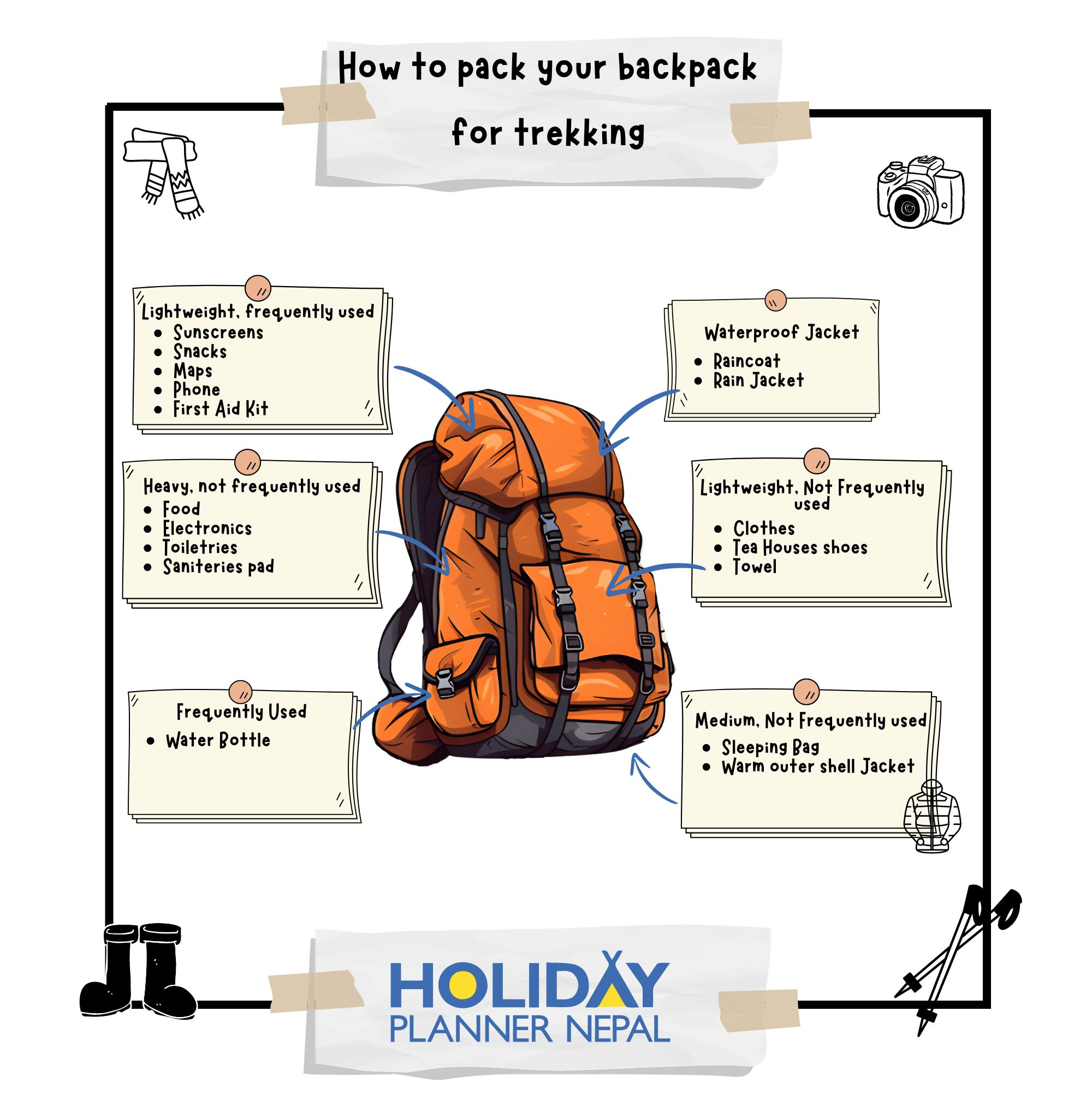
                                                  Essential Bagpack for Tsum Valley Manslu Trek

                                                  Note: Supplies and gear can be rented or purchased in Kathmandu. Once you are in Nepal, you can buy supplies and gear for hiking if you have spare time. Holiday Planner Nepal representatives will assist you in purchasing the equipment. Thamel a tourist hub, offers a wide range of trekking equipment at affordable prices. Don't wear short clothes inside the monasteries and religious places.

                                                  Step by step process to get the Visa after landing in Nepal and what is the cost for visa in 2025?

                                                  • Follow the signs or the instructions of the persons and proceed to the arrival hall first.
                                                  • Fill out the arrival card that is provided at the immigration area or use the kiosk machine.
                                                  • Staffs and there are signs that will guide you to fill the form, paying the fees and getting visa.
                                                  • After filling the form procced to the dedicated counter to pay the visa fee.
                                                  • Visa fees can be paid in dollars, euro, pound and Nepali rupees is also accepted.
                                                  • For 2025 there is a on arrival visa, and the cost for a visa is USD 30 for 15 days. For 30 days the visa cost is USD 50; for 90 days, the visa cost is USD 125.
                                                  • After paying the fees present your passport, visa application, arrival card and payment receipt at the immigration counter.
                                                  • After all this process the immigration officer will issue the visa.
                                                  • After getting the visa you can come out of the airport and meet our representatives who will be waiting with a name plate outside the airport.
                                                  • As you walk out of the airport and cross the road you will meet our airport representative who will take you to the hotel and after that we will meet and talk in detail about the trip.

                                                  Advantages of planning your trip with us

                                                  • Pick-up and drop-off services for all passengers upon international arrival and departure.
                                                  • Well-trained, experienced, fluently English-speaking guide, and a strong sherpa or porter for carrying the duffel bag.
                                                  • Welcome dinner upon arrival with cultural Nepali dances.
                                                  • Three meals a day and tea or coffee during the trek, with accommodation in the mountains.
                                                  • First-aid kit box and first-aid services.
                                                  • We provide Holiday Planner Nepal’s maps, t-shirt, and cap.
                                                  • Down jackets and sleeping bags are available for rent.
                                                  • We organize custom services as per the requests of our clients.
                                                  • Arrangement of emergency evacuation service (must be paid by the client or insurance).
                                                  • We provide an oximeter to check your pulse, oxygen saturation, and heart rate.
                                                  • We provide oxygen cans during high-altitude treks.
                                                  • We provide SIM cards for travelers, so there won’t be any communication issues.

                                                  Other Trekking & Adventure Options

                                                  Yoga & Trekking Packages

                                                  Conclusion 

                                                  Embarking on the Manaslu Tsum Valley Trek or any of these incredible Nepalese adventures is more than a journey—it’s an experience of stunning landscapes, rich culture, and unforgettable memories. Whether you’re chasing towering Himalayan peaks, exploring ancient villages, or enjoying the serene beauty of Nepal’s hidden valleys, there’s a perfect package for every adventurer.

                                                  🌟 Ready to plan your next adventure?

                                                  Contact us today to customize your trek, secure permits, and make your Himalayan journey truly unforgettable!

                                                  Tsum Valley Manaslu Trekking - 24 Days FAQs

                                                  • The Tsum Valley–Manaslu Trek is a long, culturally rich journey that combines Tsum Valley, a sacred Himalayan region influenced by Tibetan Buddhism, with the Manaslu Circuit, circling the world’s 8th-highest mountain. It is one of Nepal’s most remote and spiritually significant trekking routes.

                                                  • This trek is considered challenging because:

                                                    • It is 24 days long

                                                    • Trails are remote with limited facilities

                                                    • You cross Larke La Pass (5,160m)
                                                      Good fitness and prior multi-day trekking experience are highly recommended.

                                                  • Tsum Valley is known for:

                                                    • Ancient monasteries (Mu Gompa, Rachen Gompa)

                                                    • Unique Buddhist traditions and meditation caves

                                                    • The “Hidden Valley of Happiness” (Beyul), according to local legend

                                                    • Stunning landscapes and untouched cultural heritage

                                                    • Low tourist traffic compared to other regions

                                                  • The highest point is Larke La Pass (5,160m) during the Manaslu portion.
                                                    Tsum Valley itself reaches around 3,700m.

                                                  • You need three major permits:

                                                    • Manaslu Restricted Area Permit (RAP)

                                                    • Tsum Valley Restricted Area Permit (TVRAP)

                                                    • Manaslu/Annapurna Conservation Area Permits (MCAP & ACAP)
                                                      A licensed trekking guide is mandatory due to restricted area rules.

                                                  • The ideal seasons are:

                                                    • Autumn (Sept–Nov) – Best weather and visibility

                                                    • Spring (Mar–May) – Warmer days, rhododendrons, stable conditions
                                                      Winter is extremely cold at the pass; monsoon brings heavy rain.

                                                  • Accommodation is in local teahouses throughout the trek.
                                                    In Tsum Valley and higher Manaslu areas, facilities are more basic with simple rooms and shared bathrooms.

                                                  • Teahouses provide:

                                                    • Dal Bhat (Nepali staple meal)

                                                    • Noodles, soups, pasta

                                                    • Potatoes, eggs, pancakes

                                                    • Tibetan bread, tea, coffee
                                                      Vegetarian options are common. Meals get simpler in remote villages.

                                                  • Most days involve 5–7 hours of walking.
                                                    The day you cross Larke Pass can take 8–10 hours, depending on pace and weather.

                                                  • Yes, especially in high Manaslu areas.
                                                    The itinerary includes acclimatization days in:

                                                    • Chhekampar (Tsum Valley)

                                                    • Samagaon

                                                    • Samdo
                                                      Moving slowly, staying hydrated, and following your guide’s advice keep you safe.

                                                  • Yes. You must have insurance that covers:

                                                    • High-altitude trekking up to 5,500m

                                                    • Emergency helicopter evacuation

                                                    • Medical care

                                                  • Because of its length, remoteness, and high pass, this trek is better for experienced trekkers. Motivated beginners can join if they train well beforehand.

                                                    • Sacred monasteries: Mu Gompa, Rachen Gompa

                                                    • Milarepa’s cave & meditation sites

                                                    • Tibetan-influenced culture and traditions

                                                    • Crossing Larke La Pass

                                                    • Wild landscapes and panoramic mountain views

                                                    • Rare wildlife (Himalayan thar, blue sheep)

                                                    • Less crowded trails

                                                    • Autumn: Clear skies, cold nights

                                                    • Spring: Mild temperatures, colorful forests

                                                    • Winter: Heavy snow in high sections

                                                    • Monsoon: Rain, landslides, leeches

                                                  • Phone coverage exists in some villages but becomes limited deeper in Tsum Valley and higher Manaslu. Wi-Fi may be available in a few teahouses for a small fee.

                                                  • Essential items include:

                                                    • Trekking boots

                                                    • Layered clothing

                                                    • Down jacket

                                                    • Thermal wear

                                                    • Sleeping bag (-10°C to -15°C)

                                                    • Headlamp

                                                    • Water purification

                                                    • Power bank

                                                    • Trekking poles

                                                  • The trek begins with a drive from Kathmandu to Machha Khola (approx. 8–9 hours).
                                                    After finishing in Dharapani, you drive back to Kathmandu or Pokhara.

                                                  • Guides are mandatory due to restricted area permits.
                                                    Porters are highly recommended for comfort and safety on long days.

                                                    • Remote Buddhist villages

                                                    • Rachen Gompa & Mu Gompa

                                                    • Meditation caves of Milarepa

                                                    • Unique Tsum culture and traditions

                                                    • Epic views of Himalchuli, Ganesh Himal, and Sringi Himal

                                                    • Fewer tourists and peaceful environment

                                                  Client Reviews
                                                  Similar Holidays
                                                  We Acceptcards