Lumba Sumba Pass Trekking - 22 Days

Tripadvisor4.9(50 reviews)
Google4.9(57 reviews)

The Lumba Sumba Pass Trek is a remote Himalayan adventure, crossing the 5,177 m Lumba Sumba Pass. Trekkers enjoy breathtaking views of Kanchenjunga and Makalu, experience authentic Rai, Limbu, and Sherpa cultures, and traverse pristine forests, alpine meadows, and traditional villages. Ideal for those seeking solitude, challenge, and natural beauty.

Trip Information
  • Duration22 Day
  • DestinationNepal
  • Difficulty Level Challenging
  • Group Size1+

Highlights for Lumba Sumba Pass Trekking

  • On the off beaten tracks within tranquil surroundings and quaint farm villages.
  • Adventure beyond north of massive  Mt. Kanchenjunga  world 3rd highest peaks.
  • Enchanting woodlands of tall rhododendron, magnolia, birch, pines and fir trees.
  • Explore the hidden pockets of remote north eastern Himalaya region of Nepal.
  • Sweeping panorama of dramatic country with high snow mountain ranges.
  • Follow the old Trans Himalaya trade route, and cross high  Lumba-Sumba pass.

Introduction: Lumba Sumba Pass Trekking

The North Kanchenjunga Lumba Sumba Pass Trekking is an extreme adventure that takes you deep into the remote eastern Himalayas of Nepal, north of the towering Mt. Kanchenjunga, the world’s third-highest peak at 8,586 m (28,169 ft). Designed for experienced trekkers, this journey offers a true wilderness experience far from the crowded trails and tourist routes.

Situated in the far northeast of Nepal’s Taplejung district, this trek explores one of the least ventured corners of the Himalayas. The route follows ancient Trans-Himalayan salt trade and caravan trails toward the southeastern border of Tibet, revealing pristine landscapes, rolling green hills, high alpine valleys, and majestic snow-capped peaks. Along the way, trekkers pass through traditional villages inhabited by Bhotia and Sherpa communities of Tibetan heritage, providing a rare cultural glimpse into the lives of high Himalayan people.

The trek’s centerpiece is the Lumba Sumba Pass, standing at 5,160–5,177 m. This high Himalayan pass presents a challenging yet highly rewarding crossing that links the Kanchenjunga region in the northeast with the Makalu region in the southwest. From the pass, trekkers are treated to sweeping panoramic views of some of Nepal’s most iconic peaks, including Kanchenjunga, Makalu, and Baruntse, while navigating high alpine terrain, glaciers, and remote trails that few adventurers ever experience.

Why Choose Lumba Sumba Pass Trek?

1. Ultimate Remote Adventure – Perfect for trekkers who crave a true wilderness experience far from crowded trekking routes. This journey takes you deep into untouched Himalayan landscapes, remote valleys, and traditional villages rarely visited by tourists. Expect raw natural beauty, peaceful trails, authentic cultural encounters, and a strong sense of exploration, making it an unforgettable adventure for those seeking solitude, challenge, and pure adventure in the heart of Nepal.

2. High Himalayan Pass Challenge – Crossing the spectacular Lumba Sumba Pass (5,177 m) is a thrilling and rewarding challenge designed for experienced trekkers. This high-altitude crossing demands strong endurance and determination, while offering breathtaking mountain panoramas, dramatic glaciers, and a deep sense of achievement in one of Nepal’s most remote Himalayan regions.

3. Spectacular Mountain Scenery – Enjoy breathtaking panoramic views of some of the Himalayas’ most iconic giants, including Kanchenjunga, Makalu, Jannu (Kumbhakarna), and many surrounding snow-capped peaks. The trail offers ever-changing landscapes of glaciers, high passes, deep valleys, and alpine meadows, making every day a visual highlight of this remarkable adventure.

4. Rich Cultural Encounters – Explore authentic and culturally rich villages inhabited by Rai, Limbu, Sherpa, and Tibetan-influenced communities. Along the trail, experience traditional lifestyles, ancient customs, unique architecture, local festivals, and warm Himalayan hospitality, offering deep insight into the diverse cultures preserved in Nepal’s remote eastern regions.

5. Exceptional Biodiversity – Trek through the pristine Kanchenjunga Conservation Area, one of Nepal’s most ecologically rich regions. The trail passes through dense forests, alpine meadows, and high-altitude landscapes that are home to rare wildlife and diverse flora, including unique Himalayan plants and endangered species, making the journey especially rewarding for nature lovers and wildlife enthusiasts.

6. Diverse Landscapes – Experience an ever-changing panorama as the trail leads you from lush subtropical forests and deep river valleys to high alpine meadows, glaciers, and rugged mountain terrain. Each day reveals a new landscape, creating a dynamic and visually captivating journey that highlights the incredible geographical diversity of eastern Nepal.

7. Trans-Himalayan Experience – This unique trek links the Kanchenjunga and Makalu regions in one epic journey, offering a rare opportunity to traverse two of Nepal’s most remote and spectacular Himalayan areas. The route showcases dramatic contrasts in landscapes, cultures, and ecosystems, creating a once-in-a-lifetime adventure across the eastern Himalayas.

8. True Sense of Achievement – With far fewer trekkers on this route, completing the journey offers a profound sense of accomplishment. The solitude, challenges, and untouched beauty make it an exclusive Himalayan adventure, leaving trekkers with lasting memories and the pride of exploring one of Nepal’s most remote and rewarding trails.

Major Attractions of Lumba Sumba Pass Trekking

  • Remote High Himalayan Pass – Crossing the challenging Lumba Sumba Pass (5,177 m) is the highlight, offering a true adventure in an untouched region.

  • Spectacular Mountain Views – Panoramic views of Kanchenjunga, Makalu, Jannu, and other eastern Himalayan peaks.

  • Off-the-Beaten-Path Experience – One of Nepal’s least crowded treks, ideal for trekkers seeking solitude and wilderness.

  • Rich Biodiversity – Trek through Kanchenjunga Conservation Area, home to rare flora, red pandas, snow leopards, and diverse birdlife.

  • Cultural Diversity – Experience authentic lifestyles of Rai, Limbu, Sherpa, and Tibetan-influenced communities.

  • Dramatic Landscapes – Dense forests, alpine meadows, deep valleys, glacial rivers, and high mountain terrain.

  • Linking Two Famous Regions – Connects Kanchenjunga and Makalu regions, making it a unique trans-Himalayan trek.

  • Pristine Villages and Monasteries – Traditional villages, ancient monasteries, and centuries-old trade routes.

How does Lumba Sumba Trek start and End

The Lumba Sumba Trek is one of Nepal’s most remote and adventurous high-altitude treks. The journey begins with your arrival in Kathmandu, where you are welcomed and transferred to your hotel to rest and prepare for the adventure ahead. After initial preparations and a briefing, you take a domestic flight to Bhadrapur, followed by a scenic drive through rolling hills and tea gardens to Suketar, the gateway to the high Himalayas. From Suketar, the trek starts on foot, gradually ascending through lush forests, terraced fields, and traditional villages inhabited by Rai, Limbu, and Sherpa communities, offering a rich cultural experience along the way.

As you progress, the terrain becomes more rugged and alpine, with panoramic views of some of the world’s highest peaks, including Kanchenjunga, Makalu, and Jannu. The highlight of the trek is crossing the Lumba Sumba Pass (5,177 meters), a challenging yet rewarding high mountain pass that offers breathtaking 360-degree Himalayan vistas. After the pass, the trek descends through the remote Arun Valley, passing by pristine rivers, forests, and small villages like Num, where you can experience authentic local lifestyles.

The journey concludes with a drive from Num to Tumlingtar, followed by a flight back to Kathmandu, where you have free time to explore the city, shop for souvenirs, or relax before your departure from Nepal. The trek offers an unparalleled combination of adventure, natural beauty, cultural immersion, and a sense of accomplishment, making it ideal for trekkers seeking an off-the-beaten-path Himalayan experience.

Outline Lumba Sumba Pass Trek Itinerary

Day 01: Arrival in Kathmandu Airport and transfer to Hotel.

Day 02: Full day in Kathmandu with half day sightseeing tour at places of interest.

Day 03: Fly to Bhadrapur and drive to Ilam town

Day 04: Drive to Suketar and trek to Mitlung

Day 05: Trek to Chirwa.

Day 06: Trek to Lungthang.

Day 07: Trek to Holung / Walangchung-Gola.

Day 08: Rest day at Walangchung - Gola.

Day 09: Trek to Lumba Sumba.

Day 10: Cross over Lumba Sumba la.

Day 11: Trek to Thudam.

Day 12: Trek to Kharka.

Day 13: Trek to Chyamtang.

Day 14: Trek to Hon-Goan.

Day 15: Trek to Hatiya.

Day 16: Trek to Gola.

Day 17: Trek to Gadhi-Danda.

Day 18: Trek to Num.

Day 19: Drive to Tumlingtar for overnight in the local Lodge.

Day 20: Fly to Kathmandu and transfer to a hotel.

Day 21: In Kathmandu free day for individual activities.

Day 22: Final International departure from Nepal.

We can customize the Lumba Sumba Pass Trek Itinerary to suit your needs, whether you prefer a relaxed pace with extra time in villages, additional sightseeing stops, or more challenging trekking days. Every journey can be tailored to match your interests, fitness level, and schedule, ensuring a personalized Himalayan experience that’s both enjoyable and memorable.
Itinerary
Expand AllCollapse All

On main arrival in Kathmandu and Nepal International airport, received by our guides, and staff for short transfer in the heart of Kathmandu city around Thamel area. Where your hotel is located, after getting refreshed in your lovely room and then join with other members of North Kanchenjunga Lumba-Sumba Pass Trekking. Our guide will provide a briefing that includes all information required for the trek as well your stay in Nepal for 18 days or more.

Evening a group welcome dinner in a nice restaurant, with a complete Nepalese ambiance, enjoy lovely Nepali dishes along with a folk cultural program to entertain while you have your nice dinner.  


    Morning, depart from the hotel for exciting tour around Kathmandu at places of great interest,  Kathmandu city and its valley steeped with historical and religious monuments temples and monasteries listed as World Heritage Sites.

    After an interesting tour afternoon free to relax and preparation for Lumba Sumba Pass Trekking next early morning flight to Nepal Far South East around Terai belt.

      As per flight to reach Bhadrapur airport for the adventure, transfer to Kathmandu domestic airport for sweeping 45 minutes panoramic flight to land at Nepal Far South East at Bhadrapur. During air panorama of snow-capped mountains with views of Mt. Everest, Mt. Makalu, and Mt. Kanchenjunga.

      On landing at Bhadrapur airport where temperatures are much warmer of tropical climate, which is close to India border. At the airport received by our fields and camping staff then taking a local four-wheel drive to reach higher mid-hills. An interesting drive to Ilam town, famous for tea garden as well its nice tea flavor, at Ilam for overnight stop in a best available lodge and hotels. Afternoon with time to explore the interesting town of Eastern Nepal and to catch local culture. 

        Start the morning with lovely views of Kanchenjunga, and beautiful landscapes of green hills with pine trees and a vast tea garden. As morning drive leads on rough jeep tracks thorough villages and farmlands with short and ups to reach at Suketar, a small town with an airport where flights are unpredictable due to mountainous location, and weather-wise.

        From Suketar, get organized as our porters carry you bigger baggage then follow our guide for the first-day walk, with a short climb to reach Mitlung village, a nice farm area overlooking views of distant snow peaks. Overnight in tented camps near the village on fields and terraces. 

          After a first overnight in tented camping and food served by our cook and kitchen staff, after breakfast ready for another day lovely walks, as morning route follows downhill towards Tamor River, fed from the glaciers of Kanchenjunga, Mt. Jannu, and Kabru peaks.

          Walk leads with short ups and downs to reach at Sinwa village from the river, and the again descends to Tawa village to cross few streams and walk past spread-out farm villages, to Chirwa for overnight camp. A nice moderate size village with mixed tribes, mostly Rai (Kirat tribe) the main mid-hill of eastern Nepal with some Magar, Tamang and Hindu Chettries, Brahmins including few Dalits.

            From Chirwa after a good breakfast, morning leads to Sukathum village, after reaching a riverbank within mixed country with large cultivation of cardamom spices that the area of Taplejung and Ilam are famous for.

            Walk heads higher over many farm areas with short descend to overnight camp at Lungthang, a small farm village, from here air gets cooler with dramatic change of culture and landscapes as you enter within Tibetan Buddhist religion areas.


              After a pleasant overnight stop, morning having breakfast where the route leaves the main Kanchenjunga trail, heading due north within a cool shade of beautiful forest with tall rhododendron and pine trees. 

              Walk follows on the ancient route of Trans Himalaya Salt Trade route to Tibet that extends beyond Walanchung-Goal or Holung village.

              Finally reaching our destination at Holung a large village surrounded by high mountains this village with two names Walangchung - Gola and Holung, a nice perfect spot for extra days to explore around impressive high and remote village interwoven with strong Tibetan Buddhism religion and fascinating culture of age-old heritage.

                An ideal place for rest day for acclimatization before heading towards Lumba-Sumba high pass, which forms a barrier between Makalu and Kanchenjunga areas. At Walangchung-Gola explore around the village of great interest as well as visit its monastery. The houses are built with stones and woods, the people here are of Bhotia indigenous tribe with strong Tibetan culture as they have migrated from southeast Tibet hundreds of years back. The native still travel to Tibet border exchanging or bartering goods on both sides. 

                  Enjoying wonderful rest days and soaking in local immense culture, morning walk starts heading towards the confluence of Dinsangpa River, later joins with Tamur River further downstream. A walk leads to cross a small wooden bridge and then climb for few hours into rhododendron, pines, oaks and magnolia tree forest,

                  From the top then down back to Dinsangba Khola / stream again passing through yak herder’s camp called as Kharka’s and then reach a large green valley, continue walk over a black rock band to reach another valley, as day completes for overnight camp a large grassy meadow.

                    Today a big day for the climb and traverse to another scenic area of Makalu region, starting early morning for the long day walks climb on a faint path towards North West, where an icy stream flows from a high rocky cliff edge. 

                    After few hours of good steady climb reach a small pond, from here climb over a plateau and beyond to Lumba Sumba-La pass at 5,160 meters. The highest point of the adventure. Rewards incredible views as far towards Mt. Everest, Lhotse, and the closest Makalu, Khumba-Karna Himal with Mt. Kanchenjunga in the east direction.

                    From the top head downhill losing almost 600 meters of long descend to reach a wide valley, where overnight camp is set on a large pasture field at 4,500 m, the highest camping spot of the trek.

                      From here onwards back into villages, after spending in complete wilderness for some days, from the camp walk leads towards Makalu area on gradual descend with short climb to reach at Thudam. A nice village of Tibetan style similar culture and tribe-like at Holung village. 

                        After being around remote parts of eastern Nepal, morning walk into the dense forest to camp at Kharka (Sheppard’s shelter), as route leads through thick vegetation of bushes and tall trees then downhill to the river, with short climb in between but with more descend to reach isolated spot around Yak herders camp known as Kharka for overnight camp.

                          Another long day trek of the adventure to reach our next overnight camp at Chymatang. Start the morning much earlier and then heads for a short climb to reach a small village above Arun River. A walk and climb continues for some hours to cross over a small pass, facing grand views of surrounding dramatic landscapes with snow peak, and then a long descend on muddy and wet path to Arun River. 

                          From here cross a bridge that leads to another steep climb to reach our overnight camp at Lhomi village and Chyamtang both villages are linked closely together. 

                            From the village of Chyamatang, morning walk leads on a nice moderate trail with short ups and down past spread-out rural farm villages to a village close to a big landslides section of 2012. Which damaged many houses and primary schools, from this village, a nice walk to Hon-Gaon for overnight camping near the village farmyard.

                              A pleasant overnight stop at friendly and interesting Hon-Gaon, morning walk from this small village, where leads to low and warm areas as walk continues following Arun River downstream which is fed from the glaciers of Mt. Makalu and Baruntse Himal that flows near Tumlingtar tor join Sun Kosi on the flatland of Nepal Terai. Walk across several farmlands and villages to reach overnight camp at Hatiya village, a popular village located on the trade route to Tibet from the Makalu area within the Sankhuwa Sabha district. 

                                After a wonderful overnight stop at Hatiya village and its nice farmyard, morning walk through several smaller farm villages within heavily cultivated terrace of rice paddies, the walk continues following the main trail for five hours, and then descend with short steep up to Gola for overnight camp neat the farm village.

                                This is just Gola, don’t be confused with Walanchung-Gola of previous overnights before Lumba-Sumba pass.

                                  From Gols onwards within heavily cultivated farm areas and nice villages of mixed race of hill people with Kirat Rais, Magar, Gurung, Chettries, Brahmins and some Dalits as the culture blends among with the friendly warm villagers.

                                  Walk gets more interesting passing many cheerful local as you pass by from one village to another on nice gradual trail to reach Gadhi-Danda / ridge for overnight stop, offers views of Jaljala rocky peaks with Milke Danda green rolling hills.

                                    The last day walk of the adventure as morning heads down to a river, and then climb up towards rural small villages with terraced farms, then enter the cool shade of the forest and then ending the day on reaching at Num village, located on a high ridge where trek to Makalu base camp and beyond begins from the lovely village.

                                    In the past decade motorable road has reach this village that links to Tumlingtar and Khandbari, headquarter of the district and Makalu area.

                                    Overnight in a local simple fine and well-kept lodge severs as Tea-Houses, with time here to explore this small village facing views of surrounding beautiful landscapes and snow-clad peaks.

                                      Our walk ends at Num village, as a morning drive on local transport jeeps or similar four-wheel drives takes you to the final last overnight stop in Tumlingtar, a nice town with a sub-tropical climate. From Num on rough mountain roads, past villages facing views of surrounding green hills and peaks. After few hours of drive reaching a large town of Khadbari, a major town and headquarter of Sankhuwa Sabha district and Makalu region. After a short refreshing stop continue to drive downhill to Tumlingtar for the last overnight stop before Kathmandu in the comfort of a nice lodge. Enjoy the last dinner and bid farewell to camping staff and porters with gratitude.

                                        Morning or by mid-afternoon as per the time for flight to Kathmandu, transfer to Tumlingtar airport, located on shelf above Arun River and short walking distance from the town. Then board in an aircraft for a sweeping scenic flight back to Kathmandu, overlooking views of Himalayan peaks as the plane lands at Kathmandu, and then transfer to your hotel. 

                                          Reserved a free and spare as contingency day, in case of flight delay and cancellations which can happen sometimes even in good season of the year, due to bad and unfavorable weather condition. If all goes well according to our planned itinerary days, enjoy your last day in Kathmandu and Nepal for free individual activities and shopping, or take a tour around Kathmandu valley cities of great interest steeped with world heritage sites to enjoy. 

                                            Last day in the land of high mountains and colorful culture, with your time for international flight depart from the hotel, our staff and guide transfer you to airport, enjoying great adventure and experience on North Kanchenjunga Lumba-Sumba Pass Trekking. 

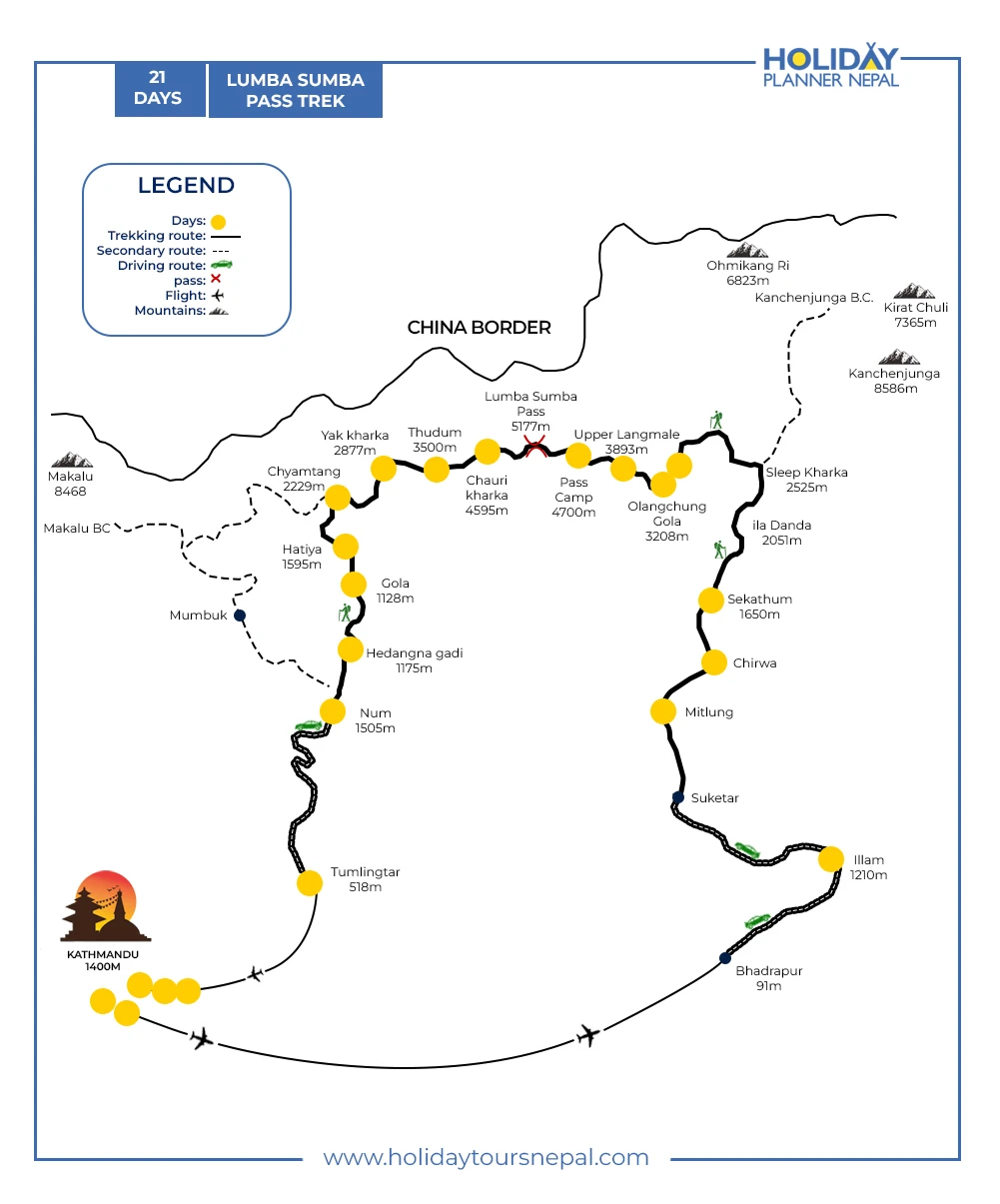
                                              Route Map

                                              Lumba Sumba Pass Trekking - 22 Days map
                                              Cost Details
                                              What's Included
                                              • All airports pick up drop by private vehicle
                                              • 04 night twin/double shearing deluxe accommodation on BB in Kathmandu
                                              • Guided sightseeing tours in Kathmandu with private vehicle (entrance fees extra) Welcome dinner in Authentic Restaurant
                                              • Kathmandu to Taplejung and Tumlingtar to Kathmandu by flight
                                              • Kanchenjunga and Makalu Conservation Area Permit, Kanchenjunga and Makalu Special permit
                                              • Twin/double shearing accommodation in the mountain during the trekking
                                              • Three meals a day; breakfast, Lunch and Dinner and tea/coffee during the trekking
                                              • A highly experience, helpful, knowledgeable, friendly, English speaking, well-trained, Government license holding guide. Price includes his salary, food, drinks, accommodation, transport and insurance.
                                              • 02 guest to 01 porter with their insurance, salary, food, accommodation and equipment
                                              • Your cost includes insurance, wages, food and lodging for both your guide and porter. We take excellent care of our guides and porters; they are like family to us.
                                              • All applicable government and local taxes per the itinerary
                                              What's not Included
                                              • Nepal Visa fee (Bring accurate fee in USD and two Passport size Photo)
                                              • International airfare to and from Kathmandu (no need to pay departure tax for international flight)
                                              • Diner and lunch in Kathmandu
                                              • Personal  travel and health Insurance, Insurance for helicopter evacuation
                                              • Extra night accommodation and lunch and dinner in city because of early arrival, late departure and early return from the mountain (due to any reason) then the scheduled itinerary
                                              • Personal expenses (phone calls, baggage charge, laundry, bar bills, battery recharge, extra porters, bottle or boiled water, shower etc)
                                              • Tips to the trekking crews and drive
                                              • Extra expenses due to flight delays, strikes, weather condition or any event out of our control
                                              • Anything not included in service includes column
                                              Availability
                                              • The trip departs everyday if the year
                                              • The trip and trek is fully customizable we can customize the trip according to the need and necessity of our clients

                                              • The trip is available for solo travelers group travelers and private travelers

                                              • We organize the trip for a large group and can provide service for a group of 100+ members as well

                                              • If the given date are not appropriate for the travllers and trekkers the trip can be conducted on the custom date provided by our clients

                                              • Holiday tours Nepal advises all our clients to book at least 7 days prior so all the arrangements can be done in time specially sometimes in themountains the accommodation are booked prior so prior booking helps a lot

                                              Contact us at [email protected] or send us a text at +977-9816710843 or +977-9818178630 we are available 24/7 on whatsapp viber wechat for additional informations.

                                              Useful Information

                                              Lumba Sumba Pass Trekking Permits 

                                              To trek the Lumba Sumba Pass, you need the following permits:

                                              1. Kanchenjunga Conservation Area Permit (KCAP):

                                              2. Trekking Permit from Nepal Tourism Board (if applicable):

                                                • Sometimes included in the trekking package.

                                                • Ensures that trekkers are registered and supported during the expedition.

                                              3. Local Area Fees:

                                                • Certain regions along the route may charge small local fees for conservation or village support.

                                              Note: Trekking in this remote area usually requires a registered guide. Permits are generally arranged through trekking agencies, especially for international trekkers, to simplify the process.

                                              Best Season for Lumba Sumba Pass Trekking

                                              The ideal time to trek the Lumba Sumba Pass is during the spring (March to May) and autumn (September to November) seasons.

                                              • Spring (March–May):

                                                • The weather is mild and stable.

                                                • The rhododendron forests are in full bloom, creating colorful landscapes.

                                                • Clear skies provide spectacular mountain views of Kanchenjunga, Makalu, and Jannu.

                                              • Autumn (September–November):

                                                • Post-monsoon season ensures dry and clear conditions.

                                                • Visibility of high peaks is excellent, making photography ideal.

                                                • Moderate temperatures make trekking comfortable and safer.

                                              Winter (December–February) is cold and snowy, making high passes like Lumba Sumba more challenging. Monsoon (June–August) is not recommended due to heavy rainfall, landslides, and slippery trails.

                                              Accommodation and Food on Lumba Sumba Pass Trek

                                              On the Lumba Sumba Pass Trek, accommodation is mainly in basic tea houses and mountain lodges scattered along the remote trail. These lodges provide clean, simple rooms, usually double-bedded, with shared bathrooms. Some lodges at lower elevations may offer attached bathrooms on request, but as you approach higher altitudes, especially near the Lumba Sumba Pass (5,177 m), facilities become very basic, sometimes limited to mats, blankets, and minimal heating. Despite this, the lodges are safe, warm, and provide a unique opportunity to experience the hospitality and daily life of local communities, including Rai, Limbu, and Sherpa villages.

                                              Food on the trek is primarily Nepali and Tibetan cuisine, designed to meet the energy needs of high-altitude trekking. Common meals include dal bhat (lentils with rice), soups, noodles, momos, and local vegetables, accompanied by hot beverages such as tea, coffee, and hot chocolate. Some lodges also offer occasional western-style meals, though options may be limited. At higher elevations, ingredients have to be carried from lower regions, so meals may be more limited and slightly costlier.

                                              Trekkers are encouraged to carry their own snacks, energy bars, or favorite foods, especially for long and demanding trekking days. Tea houses also offer a chance to interact with locals, learn about their traditions, and enjoy the peaceful mountain environment. Overall, while accommodation and food are simple and basic, they provide the essentials for comfort and energy, allowing trekkers to focus on the stunning scenery, cultural experiences, and adventure of the Lumba Sumba Pass Trek.

                                              Altitude Sickness During the Lumba Sumba Pass Trek

                                              The Lumba Sumba Pass Trek reaches high altitudes, with the pass itself at 5,177 meters (16,980 ft), making altitude sickness (Acute Mountain Sickness – AMS) a potential risk. Symptoms may include headache, nausea, dizziness, fatigue, shortness of breath, and difficulty sleeping.

                                              Key Points to Stay Safe:

                                              • Gradual Acclimatization: The trek is designed with slow ascents and rest days to allow your body to adapt to higher altitudes.

                                              • Stay Hydrated: Drink plenty of water to prevent dehydration, which can worsen symptoms.

                                              • Listen to Your Body: Do not push yourself if you feel unwell; rest and descend if symptoms persist.

                                              • Avoid Alcohol and Smoking: These can increase the risk of altitude sickness.

                                              • Medication: Some trekkers use acetazolamide (Diamox) under medical advice to help prevent AMS.

                                              Important: Mild symptoms are common at high altitudes, but severe altitude sickness can be dangerous. Trekkers should never ignore warning signs and always follow guide instructions.

                                               Is Travel Insurance Required for Lumba Sumba Pass Trekking?

                                              Yes, travel insurance is highly recommended—and in many cases essential—for Lumba Sumba Pass Trekking. This trek involves high-altitude hiking, remote trails, and challenging terrain, which carry inherent risks such as injuries, altitude sickness, or unexpected delays.

                                              Key Reasons to Have Travel Insurance:

                                              • Medical Emergencies: Covers treatment for altitude sickness, injuries, or illness during the trek.

                                              • Evacuation Costs: High-altitude rescues or helicopter evacuations can be extremely expensive without insurance.

                                              • Trip Cancellations or Delays: Protects against unforeseen events like weather disruptions, flight cancellations, or political situations.

                                              • Lost or Damaged Gear: Provides coverage for lost luggage, trekking equipment, or personal belongings.

                                              Tip: Choose a travel insurance policy that specifically covers high-altitude trekking (up to 6,000 meters) and includes emergency evacuation. Most trekking agencies will require proof of insurance before the trek.

                                              Local Culture Along the Lumba Sumba Pass Trek

                                              The Lumba Sumba Pass Trek passes through some of the most remote and culturally rich regions of eastern Nepal, offering trekkers a unique opportunity to experience authentic Himalayan life.

                                              • Ethnic Communities: The trail passes through villages inhabited by Rai, Limbu, Sherpa, and Tibetan-influenced communities, each with distinct traditions, languages, and lifestyles.

                                              • Traditional Villages: You’ll see stone and wood houses, terraced fields, and villages that have preserved ancient architecture and customs.

                                              • Festivals and Rituals: Depending on the season, trekkers may witness local festivals, religious rituals, and community gatherings reflecting the spiritual life of these communities.

                                              • Handicrafts and Art: Villagers often practice traditional weaving, wood carving, and handicrafts, giving trekkers insight into local art forms.

                                              • Religious Sites: The route includes small monasteries, stupas, and prayer flags, reflecting Buddhist and animist traditions coexisting with everyday life.

                                              • Hospitality: Local families are known for their warm hospitality, offering homemade meals, tea, and a glimpse into daily life in the high Himalayas.

                                              Overall, the trek is not just about stunning mountain views, but also a cultural journey, allowing trekkers to interact with locals, learn about their traditions, and experience life in one of Nepal’s most untouched regions.

                                                Equipment List for Lumba Sumba Pass Trek

                                                GeneralGeneral

                                                • Four-season (-20 degree) sleeping bag (We provide rental sleeping bags available for an additional USD 35)
                                                • Puffy down jacket (We provide rental jackets for an additional USD 35)
                                                • Daypack (25-30 liters recommended) with rain cover

                                                CatUpper Body

                                                • Sun hat or cap (We'll provide you with a trekking cap.)
                                                • Warm woolen hat
                                                • Scarf/Neck Buff (highly recommended to get saved from wind and cold)
                                                • Headlamp or mobile torch light for nighttime
                                                • Polarized sunglasses

                                                TorsoTorso

                                                • Technical fabric base layer thermals are light for warmer months, heavy for colder months
                                                • Technical fabric t-shirts and sleeve sweaters or high-necks
                                                • Waterproof rain jacket
                                                • Windproof jacket for the walk as it gets windy
                                                • Fleece jacket or down jacket

                                                LowerLower Body

                                                • Thermals inner
                                                • Hiking pants at least 3
                                                • Comfortable pants for teahouses
                                                • Waterproof, windproof shell
                                                • Hiking shorts

                                                glovesHands

                                                • Woolen gloves for the tea house
                                                • Hard-shell windproof outer gloves for the walk

                                                feetFeet

                                                • Marino Wool or comfortable, warm socks
                                                • Hiking socks
                                                • Liner socks
                                                • Trekking/hiking boots (waterproof recommended)
                                                • Crampons (For passes)
                                                • Casual shoes or sandals that are comfortable for the time in the tea house
                                                • Gaiters (lightweight for rain and snow)

                                                undergarmentUndergarments and Inner Wears

                                                • Technical fabric/quick drying (can be washed during the trek)
                                                • Sports bras (women)
                                                • Sleeping clothes as per the comfortability

                                                FirstaidFirst Aid Kits and Medications

                                                Note: Our guides carry medications, oxygen cans, and first aid kits during the trip. However, personal kits and medications are recommended.) 

                                                • Sunscreen SPF- 50+
                                                • Lip balm or Vaseline
                                                • ointment cream
                                                • Cough Syrup and strepsils (recommended for Khumbu Cough)
                                                • Creams and medicines (for any allergies or diseases)

                                                Optional Other Essentials

                                                • Passport
                                                • Extra copies of passport-sized photos
                                                • Reusable water bottle
                                                • Toilet paper, small soap, and shampoo
                                                • Water purification tablets or UV water purifier (if you plan to treat water)
                                                • Water bladder for the day bag
                                                • Small towel for personal use
                                                • Pillowcase in case of allergies to new pillows
                                                • High-protein snacks (such as mountain bars or nuts)
                                                • Waterproof/dry bags for carrying essential documents, stuff, frequently used items, and money
                                                • Power bank or extra batteries
                                                • Cameras and mobile phone
                                                • Cards/book
                                                • Pee bottle/ pee funnel for women
                                                • Trekking poles
                                                • Whistle in case your voice is not loud enough to stop or start
                                                • Thermos for hot water during the nighttime
                                                • We give you a free duffel bag, trekking cap, maps, and t-shirt during your pre-trip meeting in Kathmandu. The duffel bag will be used to pack your trekking supplies.
                                                • For every two participants, we assign one porter. The porter will carry the duffel bag, which should weigh around 10 kg/22 lbs., throughout the walk.
                                                • Daypack bag for daily used stuff like cash, documents, papers, a water bottle or bladder, a camera, toiletries, sunscreen, a notebook, clothing, etc. (with a waterproof cover).
                                                • You can store your luggage (on-trekking items) at the hotel in Kathmandu, and we can assist and help.
                                                • Total luggage for the Kathmandu-Lukla flight is (15 kg/33 lbs.), including duffel (10 Kg/22 lbs.) and backpack (5 kg/11 lbs.)
                                                • A down jacket with a hood(cap) to be warm in altitudes above 3,000m.
                                                • We can provide a down jacket for USD 35. In case of loss or damage, you need to pay back the cost of USD 200 per item.
                                                • We can provide a sleeping bag for USD 35. In case of loss or damage, USD 200 per item must be paid.

                                                What to pack for nepal trekking?

                                                Note: Supplies and gear can be rented or purchased in Kathmandu. Once you are in Nepal, you can buy supplies and gear for hiking if you have spare time. Holiday Planner Nepal representatives will assist you in purchasing the equipment. Thamel a tourist hub, offers a wide range of trekking equipment at affordable prices. Don't wear short clothes inside the monasteries and religious places.

                                                Tips for trekkers who are trekking in the Himalayas

                                                • Build stamina, practice hiking and do some hikes that involves altitude to know how your body would react in high altitude.

                                                • Let the loved ones know that you’re traveling to your family or loved ones and let them know about the agency that you’re traveling with.
                                                • Stay connected, share your itinerary, respect local customs and be honest with the guide and let them know if you’re not feeling well
                                                • Stay hydrated and nourished in the mountains and remember food is fuel if you stop consuming food remember your going to fall sick or lose energy so don’t stop eating.
                                                • Be patient stay positive and trust your instincts and remember in altitude sometimes you feel angry and can have secondary thoughts.
                                                • Check the weather forecast or ask the guide about the weather and what to wear.
                                                • Respect local traditions, leave no trace, use eco friendly products and keep the trails clean.
                                                • Keep the money, document and important documents safe
                                                • Keep the power bank, cameras and electronics safe and at night try to cover the electronics with clothes so they stay warm and don’t drain the battery.

                                                Tips for female travelers during periods in the mountains

                                                • Know your cycle and pack accordingly sanitary pads, period underwear’s, menstrual cups and tampons.

                                                • Pack sanitary pads in case sometimes the dates can be up and down and even someone might need in trek in case you don’t use it.

                                                • Bring pain relivers like ibuprofen, heat patches, to ease cramps stay hydrated and eat good nutrition food.

                                                • Wear comfortable and food layered clothing’s rest when needed and mind your mood.

                                                An Advantage of Booking a Trip with a Holiday Tours Nepal.

                                                • Private vehicles pick up and drop off passengers at all airports.
                                                • First-aid kit box.
                                                • Holiday Tours Nepal’s down jackets, t-shirts, and caps, if necessary.
                                                • Arrangement of emergency evacuation service (you should have insurance for emergency evacuation, which will be paid for by your travel insurance company).
                                                • We use an oximeter to check your pulse, oxygen saturation, and heart rate, and we provide oxygen if needed.
                                                • Sim cards are provided by our company for travelers, so there won’t be any networking issues.

                                                Here are other popular trekking packages offered by Holiday Tours Nepal

                                                Conclusion 

                                                The Lumba Sumba Pass Trek is a truly off-the-beaten-path adventure, offering breathtaking mountain views, challenging high-altitude trekking, and an immersive experience of remote Himalayan cultures. From crossing the 5,177-meter Lumba Sumba Pass to exploring traditional villages and pristine landscapes, this trek is perfect for adventurers seeking both thrill and serenity.

                                                Take the next step in your Himalayan adventure! Book your Lumba Sumba Pass Trek today with Holiday Tours Nepal and experience one of Nepal’s most spectacular and untouched trekking routes.

                                                Lumba Sumba Pass Trekking - 22 Days FAQs

                                                • Essential items include:

                                                  • Strong trekking boots

                                                  • Layered clothing

                                                  • Down jacket

                                                  • Warm gloves & hat

                                                  • Sleeping bag (–15°C recommended)

                                                  • Water purification

                                                  • Headlamp

                                                  • Power bank

                                                  • Trekking poles

                                                • The Lumba Sumba Pass Trek is a remote and adventurous route in eastern Nepal that connects the Kanchenjunga region with the Makalu–Barun National Park. It crosses the high Lumba Sumba Pass (5,160m) and offers wild landscapes, rich biodiversity, and authentic village life.

                                                • It is rated challenging.
                                                  Reasons:

                                                  • High pass over 5,000m

                                                  • Long trekking days (6–8 hours)

                                                  • Remote terrain with limited facilities

                                                  • Difficult trails that require good stamina

                                                  Prior trekking experience and strong fitness are highly recommended.

                                                • The highest point is Lumba Sumba Pass at around 5,160 meters.

                                                • You will need:

                                                  • Kanchenjunga Conservation Area Permit (KCAP)

                                                  • Makalu Barun National Park Permit

                                                  • TIMS card

                                                  A licensed trekking guide is strongly recommended for safety and navigation.

                                                • The best seasons are:

                                                  • Autumn (Sept–Nov) – Stable weather & clear mountain views

                                                  • Spring (Mar–May) – Blooming rhododendrons & mild temperatures

                                                  Winter brings heavy snowfall, and monsoon brings rain and landslides.

                                                  • Spectacular views of Kanchenjunga, Makalu, and surrounding peaks

                                                  • Rare wildlife: red panda, musk deer, snow leopard (rare sightings)

                                                  • Rich Rai, Limbu, Sherpa, and Tibetan culture

                                                  • One of Nepal’s least crowded and most untouched trekking areas

                                                  • High alpine lakes, dense forests, and wild valleys

                                                • Mostly basic homestays and simple teahouses.
                                                  Facilities can be very limited, especially in high and remote areas.

                                                • You will get simple local meals like:

                                                  • Dal Bhat

                                                  • Potatoes, eggs, noodles, soups

                                                  • Local vegetables

                                                  • Tea, coffee

                                                  Food becomes simpler the higher you go.

                                                • Daily trekking duration is usually 5–7 hours.
                                                  The pass day may take 8–10 hours depending on weather conditions.

                                                • Yes. The trek reaches over 5,000m.
                                                  The itinerary includes acclimatization days, and it’s important to:

                                                  • Walk slowly

                                                  • Stay hydrated

                                                  • Communicate with your guide if you feel unwell

                                                • Yes, travel insurance that covers:

                                                  • High-altitude trekking (up to 5,500m)

                                                  • Emergency helicopter evacuation

                                                  • Medical treatment

                                                  This is essential for this remote trek.

                                                • Not recommended for beginners due to:

                                                  • Remote terrain

                                                  • High altitude

                                                  • Limited facilities

                                                  • Challenging pass crossing

                                                  It is best for trekkers with previous multi-day trek experience.

                                                  • Crossing the Lumba Sumba Pass

                                                  • Views of Makalu and Kanchenjunga

                                                  • Pristine forests and rare wildlife

                                                  • Traditional villages and indigenous cultures

                                                  • Uncrowded, peaceful trails

                                                  • Exploring two national parks in one trek

                                                • Most itineraries start with a flight or drive to Taplejung in eastern Nepal.
                                                  The trek ends near the Makalu region, and you return to Kathmandu via local flight or road transport.

                                                • Mobile signals work in lower villages but become weak or unavailable in remote areas.
                                                  Wi-Fi is extremely rare.

                                                Similar Holidays
                                                We Acceptcards

