 4.9(50 reviews)
 4.9(57 reviews)
Highlights of Lower Dolpo Trekking
- Adventure on the ancient Trans-Himalayan Salt Trade and Caravan Trail to Tibet via Dolpo.
- Explore the vast South-West Tibetan landscapes within the world’s highest plateau.
- Visit Lower Dolpo villages enriched with ancient Bon traditions and Buddhist culture.
- See impressive old monasteries and villages with stunning views of dramatic valleys and mountains.
- Cross high passes such as Numa-la and Baga-la, offering exceptional views of snow-capped peaks.
- Trek through high, windswept, dry, and arid landscapes with beautiful scenery.
- Enjoy grand views of snow-capped peaks including Dhaulagiri, Kagmara, and Kanjiroba.
- Experience the ancient Bon sect heritage, with chances to spot blue sheep and the elusive snow leopard.
Introduction:
The Lower Dolpo Trekking is a remarkable journey into one of Nepal’s most isolated and least explored Himalayan regions, offering an authentic trekking experience far from the crowded trails. Situated in the remote north-western part of Nepal within Shey Phoksundo National Park, Lower Dolpo is renowned for its rugged terrain, dramatic landscapes, and deep-rooted Tibetan culture. The trek passes through narrow river gorges, ancient trade routes, high alpine meadows, and traditional villages where life continues much as it has for centuries. One of the major highlights of the journey is the breathtaking Phoksundo Lake, famous for its striking turquoise color and spiritual significance, along with visits to ancient monasteries that reflect strong Bon and Buddhist traditions.
This trek is ideal for trekkers seeking true wilderness, cultural immersion, and adventure. Due to its remoteness, Lower Dolpo requires special trekking permits and is usually undertaken as a fully supported trek with experienced guides. The trail crosses several high passes above 4,000 meters, making it physically demanding yet deeply rewarding for well-prepared trekkers. With its dramatic arid landscapes, snow-capped peaks, rare wildlife, and warm hospitality of local communities, the Lower Dolpo Trek offers a rare opportunity to explore a hidden corner of the Himalayas where nature, culture, and spirituality exist in perfect harmony.
Why Choose Dolpo Trekking?
Choosing Dolpo Trekking is about experiencing the Himalayas in their purest and most untouched form. Far removed from busy trekking corridors, Dolpo offers an extraordinary sense of isolation and adventure that appeals to trekkers who want to explore beyond the ordinary. The region’s dramatic geography—characterized by deep river gorges, vast high-altitude plateaus, rugged mountain passes, and stark arid landscapes—creates a visually striking and deeply immersive trekking experience unlike any other in Nepal.
One of the strongest reasons to choose Dolpo is its rich and well-preserved culture. Influenced by Tibetan Buddhism and the ancient Bon religion, Dolpo’s villages, monasteries, mani walls, prayer flags, and chortens reflect centuries-old traditions that continue to shape daily life. Trekkers gain rare insight into a lifestyle that has changed very little over time, offering meaningful cultural encounters rather than surface-level tourism. Visiting sacred sites such as Phoksundo Lake and remote monasteries adds a strong spiritual dimension to the journey.
Dolpo Trekking is also ideal for those who value true wilderness and solitude. Due to restricted access and challenging terrain, the number of trekkers remains low, allowing for peaceful trails and an authentic connection with nature. The region falls within Shey Phoksundo National Park, home to diverse flora and fauna, including rare Himalayan wildlife. While the trek is physically demanding, crossing high passes and trekking long days, it offers immense rewards—pristine landscapes, cultural depth, and a profound sense of achievement. For adventurous travelers seeking a remote, meaningful, and unforgettable Himalayan journey, Dolpo Trekking stands as one of Nepal’s finest hidden treasures.
Major attractions of the Lower Dolpo Trek
1. Shey Phoksundo Lake is a breathtaking turquoise alpine lake, renowned for its crystal-clear waters, dramatic cliffside setting, and deep spiritual significance. Located in Lower Dolpo, it is Nepal’s deepest lake and a sacred site for local Buddhist communities, surrounded by monasteries, prayer flags, and pristine Himalayan landscapes.
2. Phoksundo Waterfall is one of the highest waterfalls in Nepal, plunging dramatically from a great height and creating a spectacular landscape near Ringmo Village. Fed by the outflow of Shey Phoksundo Lake, the waterfall adds to the raw beauty of the Lower Dolpo region and is a striking highlight for trekkers visiting the area.
3. Shey Phoksundo National Park is Nepal’s largest national park, famous for its rugged terrain, deep gorges, alpine meadows, and rich biodiversity. It is home to unique wildlife such as the snow leopard, Himalayan blue sheep (bharal), musk deer, and red pandas. The park also encompasses Shey Phoksundo Lake and Phoksundo Waterfall, making it a prime destination for trekking, nature exploration, and cultural experiences with the local Dolpo communities.
4. Ancient Tibetan Culture in Lower Dolpo is deeply rooted in Tibetan Buddhism and the indigenous Bon religion. This cultural heritage is visible throughout the region in monasteries, mani walls, chortens (stupas), and colorful prayer flags fluttering across the high-altitude landscapes. Trekkers can experience traditional festivals, local rituals, and the serene lifestyle of the Dolpo people, preserving centuries-old Tibetan customs.
5. Traditional Villages in Lower Dolpo, such as Ringmo and Dho Tarap, offer a glimpse into centuries-old lifestyles and customs. These remote villages have preserved their ancient architecture, farming practices, and cultural traditions, allowing trekkers to experience authentic Dolpo life amidst the stunning Himalayan landscapes.
6. Remote & Untouched Trails in Lower Dolpo feature less-crowded routes that provide trekkers with peace, solitude, and an authentic wilderness experience. Far from the typical tourist paths, these trails wind through rugged mountains, pristine forests, and high-altitude valleys, allowing adventurers to immerse themselves fully in the region’s natural beauty and serenity.
7. High Mountain Passes in Lower Dolpo are challenging trails above 4,000 meters, offering trekkers both adventure and breathtaking panoramic views of the Himalayas. Crossing these passes provides a sense of achievement and access to stunning landscapes, including snow-capped peaks, deep valleys, and remote alpine meadows.
8. Arid Himalayan Landscapes in Lower Dolpo feature barren and semi-desert terrain, shaped by the region’s location in the rain-shadow of the Himalayas. This unique environment creates stark, dramatic scenery with rugged cliffs, sparse vegetation, and wide-open valleys, offering trekkers a rare and mesmerizing high-altitude desert experience.
How does Lower Dolpo Trek start and end
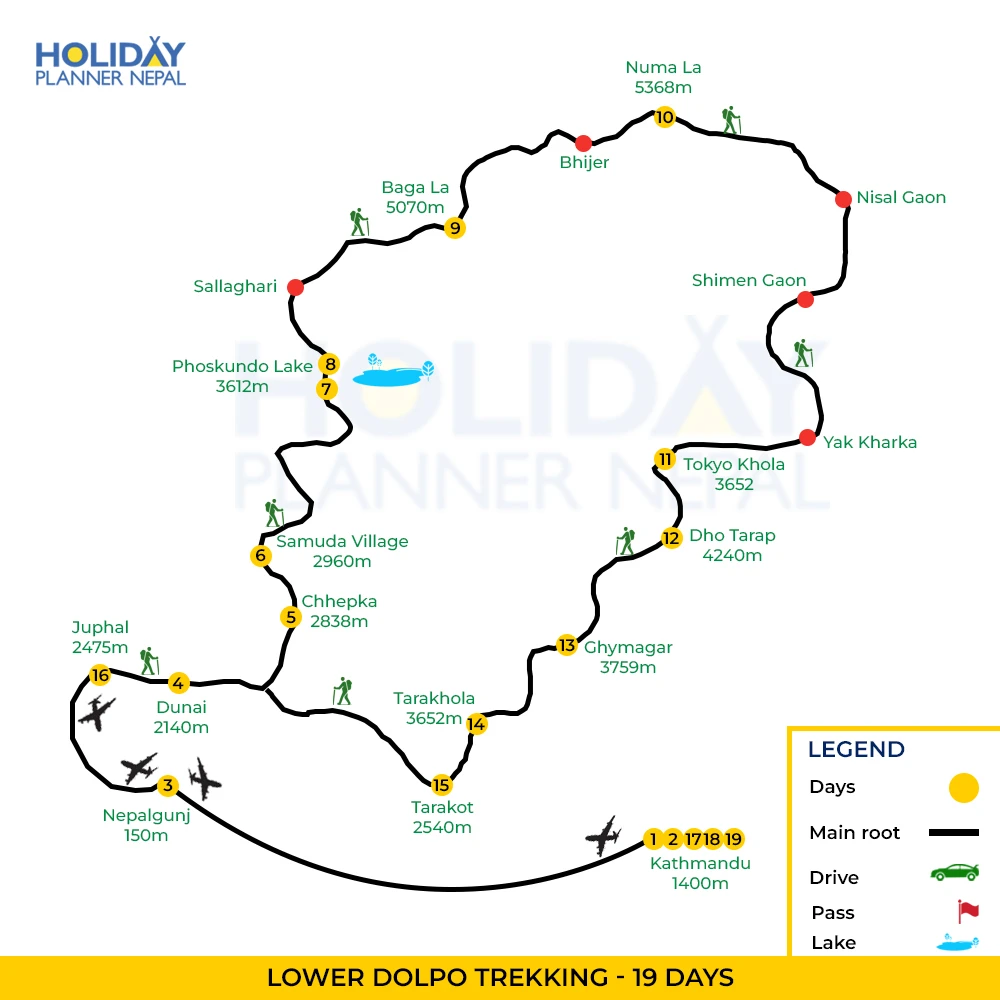
The Lower Dolpo Trek begins with a memorable flight from Nepalgunj to Juphal, offering stunning aerial views of the western Himalayan landscapes and giving trekkers an early taste of the region’s rugged beauty. Juphal serves as the entry point to one of Nepal’s most remote and culturally unique trekking areas. From here, the trail winds through remote valleys, high ridges, and traditional villages, gradually ascending to higher altitudes. Early stops in villages like Dunai and Kermi allow trekkers to acclimatize, experience local culture, and enjoy interactions with the warm and hospitable Dolpo people. As the trek progresses, adventurers traverse high passes, suspension bridges, and river gorges, encountering arid landscapes, alpine meadows, and pristine lakes that define the region’s dramatic scenery.
The trek usually concludes by returning to Juphal, where trekkers take a flight back to Nepalgunj and then continue to Kathmandu or other destinations. For those seeking extended adventure, some itineraries include Upper Dolpo or side trips to Shey Phoksundo Lake, adding extra days of exploration before the return. Alternatively, trekkers may descend via Dunai and travel by jeep to Nepalgunj, providing a different perspective of the Dolpo region. This combination of accessible start and end points, breathtaking landscapes, high-altitude challenges, and cultural immersion makes Lower Dolpo Trekking a truly unforgettable Himalayan experience.
Outline Lower Dolpo Trek Itinerary
Day 01: Arrival in Kathmandu
Day 02: Welcome dinner, trip preparation, and Kathmandu city tour
Day 03: Kathmandu to Nepalgunj (Flight)
Day 04: Nepalgunj to Juphal (Flight) – Trek to Dunai
Day 05: Dunai to Tarakot
Day 06: Tarakot to Laini
Day 07: Laini to Nawar Pani
Day 08: Nawar Pani to Dho Tarap
Day 09: Acclimatization Day at Dho Tarap
Day 10: Dho Tarap to Numa La Base Camp
Day 11: Numa La Base Camp to Pelung Tang (via Numa La Pass)
Day 12: Pelung Tang to Dajok Tang (via Baga La Pass)
Day 13: Dajok Tang to Ringmo
Day 14: Acclimatization Day at Phoksundo Lake
Day 15: Phoksundo Lake to Shyanta
Day 16: Shyanta to Juphal
Day 17: Juphal to Nepalgunj – Kathmandu (Flights)
Day 18: Free Day in Kathmandu and 60 mins trekker's massage
Day 19: International Departure
We can customize the Lower Dolpo Trek Itinerary to suit your needs, whether you prefer a relaxed pace with extra time in villages, additional sightseeing stops, or more challenging trekking days. Every journey can be tailored to match your interests, fitness level, and schedule, ensuring a personalized Himalayan experience that’s both enjoyable and memorable.
 General
 Upper Body
 Torso
Torso Lower Body
 Hands
Hands Feet
Feet Undergarments and Inner Wears
 First Aid Kits and Medications
 Other Essentials