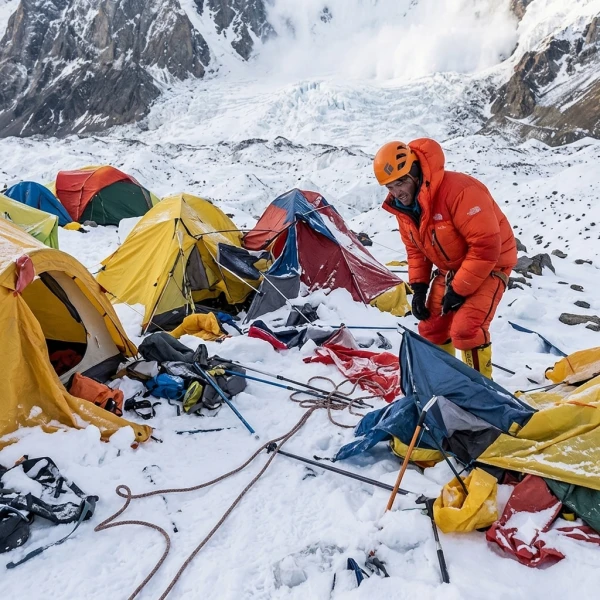
On July 30, 2026, high on the icy flanks of Pakistan's Broad Peak, a catastrophic force struck without warning. Nirmal Purja—a man who had conquered all fourteen of the earth’s 8,000-meter giants faster than anyone in recorded history—was pushing up the mountain. He was a veteran who had repeatedly ventured into the death zone to carry dying strangers to safety with his bare hands. If anyone seemed invincible against the perils of the high Himalaya, it was him. Yet on that clear morning, the ultimate rescuer became the one who needed saving. This is the complete story of Nirmal Purja’s final ascent.
Hours of Silence: Broad Peak Avalanche What Happened? Full Detail
Table of Contents
Hours of Silence: Broad Peak Avalanche What Happened? Full Detail
Key Takeaways & Article Summary:
- Incident Date: July 30, 2026 (~9:20 AM local time)
- Location: Broad Peak (8,051 m / 26,414 ft), Karakoram Range, Pakistan
- Casualties: 10 mountaineers across 5 nationalities, including Nepali high-altitude legend Nirmal "Nimsdai" Purja.
- The Event: A massive avalanche swept the standard route between Camp 2 and Camp 3 at approximately 6,600 meters.
- The Critical Gap: A 12-hour communication blackout occurred between the avalanche and the initial alert sent to base camp.
Where is Broad Peak, and why is it dangerous?
Standing at 8,051 meters (26,414 feet) in Pakistan's Karakoram range right beside K2, Broad Peak is the 12th highest summit on Earth. It carries a reputation among some as an "easier" 8,000-meter peak because it is less technically demanding than K2.
That reputation is a dangerous illusion. No peak above 8,000 meters is safe, and Broad Peak has claimed lives for generations. The primary danger on July 30 was an objective hazard: an avalanche. On these giant faces, massive snow loads accumulate above the standard climbing lines. They release unpredictably triggered by fresh snow, temperature fluctuations, or ice collapses far above. When an avalanche releases over climbers on an exposed slope, skill and strength offer no defense against a wall of sliding snow.
Weather and Conditions: The Warnings Before the Slide
In the week leading up to July 30, conditions on Broad Peak turned unstable. Heavy snowfall began blanketing the mountain around July 22. To seasoned eyes, fresh snow piled high on steep slopes is the classic recipe for an avalanche—a loaded gun awaiting a trigger.
Any climbers recognized the hazard. Hungarian climber David Klein, who spent a month on the mountain attempting an oxygen-free climb, assessed the risks and decided to abort. He noted that after heavy snowfall, safety requires several days for the new layer to either bond with the mountain or naturally slide off before it is safe to proceed. By July 25, Klein and most other teams at base camp packed their gear and departed. They listened to the mountain's warning.
Why Did Nirmal Purja Attempt Broad Peak?
A few groups chose to stay, including Purja's team. Broad Peak was a late addition to his itinerary, added to put him within one summit of an unprecedented record. On July 27, three days before setting out, Purja posted his final public message: "I take zero mountains for granted, not one. The moment my foot leaves base camp, it's 100%, always has been, always will be." Addressing the peak directly, he wrote: "Broad Peak, I asked for nothing but safe passage up and back down."
Why his team chose to climb into fresh snow after others had turned back is a question the mountaineering community continues to debate. It is not a matter of blame but an honest observation: the danger was recognized, and experienced teams had already walked away.
The Day of the Broad Peak Avalanche: July 30, 2026
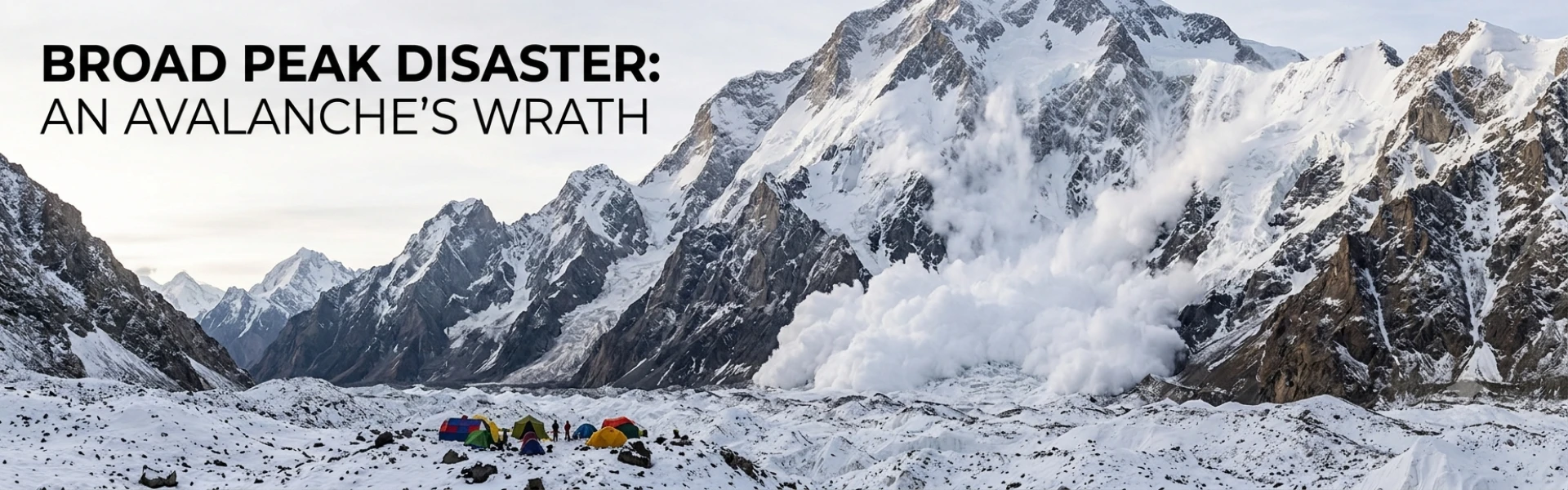
On the morning of July 30, four combined teams were moving between Camp 2 and Camp 3 on the normal route at approximately 6,600 meters. At roughly 9:20 AM, the slope gave way.
The avalanche swept down the west face, catching all 10 climbers in open terrain. Satellite trackers recorded what no eye could see: within seconds, GPS coordinates plunged hundreds of meters down the face, with some signals dropping nearly a vertical mile. Then, total silence followed.
What Happened After the Avalanche? The 12-Hour Delay
Here lies the most agonizing aspect of the tragedy: the avalanche struck around 9:20 AM, yet the emergency call to launch rescue helicopters was not dispatched until 10:00 PM that night—nearly 12 hours later.
An entire day of daylight was lost. Although teams maintain staff at base camp, nearly 12 hours passed before anyone below realized 10 climbers had been swept off the face. "We only found out at 10 p.m.," a senior Alpine Club of Pakistan official stated. "We are all shocked."
The Rescue and Recovery Operations
By sunrise on July 31, the mission was no longer a rescue but a recovery effort. In Pakistan's Karakoram region, helicopter support relies on military clearances that take time—unlike the private charter system in Nepal. Severe weather further delayed aerial ops.
In a touching act of solidarity, teams pushing for the summit on neighboring K2 abandoned their climbs and rushed to search Broad Peak. Yet the delay and the sheer force of the slide had already sealed the outcome. Ground crews, drones, and helicopters eventually located the victims. On August 1, Elite Exped officially confirmed that Purja and his entire team had died.
Garmin tracking logs provided a clear picture of Purja's final moment. Moving near the front of the group at 6,600 meters, his device recorded an abrupt 800-meter drop straight down the face. A fall of that distance in heavy avalanche debris leaves virtually no chance of survival. Faint tracker movements reported later were attributed to snow settlement carrying the detached device rather than a sign of life.
Who Was Nirmal Purja (Nimsdai, MBE)?
To comprehend why this tragedy sent shockwaves around the globe, one must understand the legendary figure at its center. Born in 1983 in the lowlands of Nepal, Nirmal "Nimsdai" Purja followed his father's path by enlisting in the British Army’s Brigade of Gurkhas. He later made history as the first Nepali to join the Special Boat Service (SBS)—the elite special forces unit of the Royal Navy. Entering elite mountaineering relatively late in his thirties, Purja swiftly dismantled long-held assumptions about human endurance.
In 2019, he launched "Project Possible," an audacious campaign to climb all 14 eight-thousand-meter summits within a single seven-month window. Mountaineering traditionalists initially dismissed the attempt as a publicity stunt, given that the prior record stood at nearly eight years. Purja shattered those doubts by completing the entire circuit in just 6 months and 6 days (189 days). The achievement was captured in the hit Netflix documentary 14 Peaks: Nothing Is Impossible, launching him to global stardom and earning him an appointment as a Member of the Order of the British Empire (MBE).
His momentum never slowed. By 2024, Purja had completed the entire 14-summit circuit a second time—this time without using supplemental oxygen. By the summer of 2026, he had logged over 50 successful ascents above 8,000 meters. Broad Peak came shortly after his 57th major climb. Beyond his personal feats, he established commercial guiding ventures, created a welfare foundation for Nepal's high-altitude workers, and founded an aviation business. He used his platform relentlessly to demand long-overdue respect for Sherpa and Pakistani mountain crews. He was chasing one final historic milestone: becoming the first human to climb all 14 eight-thousand-meter peaks twice entirely without bottled oxygen.
A Legacy of Rescues: The Miracle on Annapurna
Broad Peak represented the penultimate mountain in that quest, leaving only Cho Oyu to follow. Yet what truly defined Purja's legacy was his willingness to abandon personal goals to save others. Time and again, he put his own life on the line for stranded climbers.
One of his famous rescues occurred in April 2019 during Project Possible on Annapurna. A Malaysian physician, Dr. Chin Wui Kin, became stranded high on the mountain near 7,500 meters, surviving without a shelter, food, water, or supplemental oxygen for over 40 hours. By all physical logic, he should have perished. Purja held back his strongest crew members and spearheaded a daring four-man rescue effort up into the thin air. Reaching Dr. Chin in four hours, they found him conscious and brought him down the mountain alive. Though Dr. Chin tragically passed away days later in a Singapore hospital due to severe exposure, Purja later noted that administrative delays in initiating the rescue had lost critical hours.
Therein lies the unbearable irony of the Broad Peak disaster: the man who built a reputation as the world's ultimate high-altitude rescuer—who understood better than anyone how delay turns a crisis into a fatality—was ultimately the one no one could reach in time.
Who Were the 10 Climbers Lost on Broad Peak?
Purja was not alone on the mountain. Nine other climbers, spanning four separate teams, occupied the same stretch of terrain when the avalanche struck. The mountain made no distinction between legendary professionals and ambitious first-timers:
1. Nirmal "Nims" Purja, MBE (Nepal / United Kingdom)
- Role: Expedition Leader & Founder of Elite Exped
- Background: Born in Nepal, Purja served six years in the British Army's Brigade of Gurkhas before becoming the first Nepali to join the Royal Navy's Special Boat Service (SBS).
- Key Achievements: Gained international renown for "Project Possible," climbing all 14 of the world's 8,000-meter peaks in 6 months and 6 days in 2019 (featured in the Netflix documentary 14 Peaks: Nothing Is Impossible). He completed the 14-peak circuit a second time without supplemental oxygen and co-led the historic first winter ascent of K2 in 2021.
- Broad Peak Mission: Was attempting to become the first person in history to summit all 14 eight-thousand-meter peaks a second time entirely without supplemental oxygen.
2. Sohail Sakhi ("Saki") (Pakistan)
- Role: Expedition Guide & Mountaineer (Moving Mountains)
- Background: A native of Hunza, Gilgit-Baltistan, Sakhi was widely regarded as one of Pakistan's premier high-altitude mountaineers.
- Key Achievements: Had successfully summited all five of Pakistan's 8,000-meter peaks (K2, Nanga Parbat, Gasherbrum I, Gasherbrum II, and Broad Peak) and actively campaigned for oxygen-free climbing and local porter welfare.
- Broad Peak Mission: Was guiding American climber Sarah Mallory Geis on what was set to be his final local 8,000-meter summit.
3. Sarah Mallory Geis (United States)
- Role: Independent Climber
- Background: A 39-year-old travel photographer and Pilates studio owner from San Antonio, Texas.
- Key Achievements: Closed her business in early 2026 to dedicate herself to high-altitude mountaineering, training on smaller Himalayan and Karakoram peaks.
- Broad Peak Mission: Broad Peak was her first attempt on an 8,000-meter summit.
4. Pur Bahadur Gurung ("Yukta") (Nepal)
- Role: IFMGA Lead Guide & Senior Specialist (Elite Exped)
- Background: An IFMGA-certified international mountain guide and one of Nirmal Purja’s primary operational partners.
- Key Achievements: Known throughout the high-altitude community for technical precision, emergency rescue operations, and logistics management across the Himalaya and Karakoram.
- Broad Peak Mission: Was guiding on the mountain while reportedly nearing the completion of all 14 eight-thousand-meter peaks himself.
5. Nadhira Ahmed Abdullah Al Harthy (Oman)
- Role: Independent Climber (Seven Summit Treks)
- Background: High-altitude climber and pioneer from Oman.
- Key Achievements: Made history in 2019 as the first Omani woman ever to summit Mount Everest. She subsequently scaled K2 and Manaslu, inspiring women across the Arab world to pursue mountaineering.
- Broad Peak Mission: Attempting Broad Peak as part of her journey across the world's highest mountains.
6. Kili Pemba Sherpa ("Kilu") (Nepal)
- Role: Senior High-Altitude Guide (Imagine Nepal)
- Background: Veteran Nepali mountain guide hailing from the high Himalaya.
- Key Achievements: Summited Mount Everest 15 times, was a core member of the 10-person Nepali team that completed the first winter ascent of K2 in January 2021, and guided a double amputee to the summit of Everest.
- Broad Peak Mission: Serving as a primary route-fixer and guide for the expedition.
7. Nima Sherpa (Nepal)
- Role: High-Altitude Guide (Elite Exped)
- Background: Raised in a farming family in the Makalu region of Sankhuwasabha, Nepal, entering mountaineering through trekking before joining Elite Exped.
- Key Achievements: Had a record-setting year prior to the Broad Peak expedition, having successfully summited four different 8,000-meter peaks in the 2026 season alone.
- Broad Peak Mission: Managing route setting and client support between Camp 2 and Camp 3.
8. Nawang Thindu Sherpa (Nepal)
- Role: High-Altitude Specialist & Route Support
- Background: Veteran high-altitude climber from Nepal.
- Key Achievements: Provided essential high-altitude support, rope-fixing, and logistics across major Himalayan and Karakoram peaks.
- Broad Peak Mission: Setting fixed lines and managing high-camp logistics above Camp 2.
9. Gyalu / Gyaljen Sherpa ("Gyalu") (Nepal)
- Role: High-Altitude Guide (Seven Summit Treks)
- Background: Native of Okhaldhunga, Nepal, who began climbing professionally in 2015.
- Key Achievements: Held a Guinness World Record for summiting Kanchenjunga (8,586 m) three times in a single climbing season, alongside ascents of Everest, Manaslu, Cholatse, and Lenin Peak.
- Broad Peak Mission: Guiding and high-altitude support for the international climbers.
10. Wang Zhong (China)
- Role: Independent Climber
- Background: A 52-year-old high-altitude mountaineer from China.
- Key Achievements: Experienced climber who had successfully summited 12 of the world's fourteen 8,000-meter peaks prior to 2026.
- Broad Peak Mission: Broad Peak was intended to be his 13th eight-thousand-meter summit on his quest to complete all 14.
Ten individuals from five nations—renowned veterans, pioneering women, dedicated Sherpas, and enthusiastic dreamers—perished in the same instant.
The Legacy of the Broad Peak Tragedy
It is tempting to view mountain deaths as the result of reckless mistakes. Nirmal Purja’s death rejects that simple explanation. As one of the most capable climbers in history, he was felled by the indifferent force of an avalanche—a reminder of the objective hazards present at high altitude.
Yet the disaster also highlights the weight of human choices. The mountain provided clear warnings after days of snow, leading some to retreat, while a 12-hour delay slowed the initial response.
What remains clear is the depth of the loss: ten lives ended on a Karakoram slope. The tragedy reinforces a timeless truth known to all who enter the death zone: the mountain is magnificent and worth the effort, but it remains entirely indifferent to human presence. Rest in peace to all ten climbers.
Avisek Jung Thakuri Singh
Call us on WhatsApp9849370767OrChat with us