What is the best time or season for the Manaslu Circuit and Larke Pass?
Nepal mainly faces four seasons in a year: Spring, Autumn, Summer, and Winter. During these seasons, in spring and autumn, trekkers can have the best trekking experience of the Manaslu circuit.
Spring, from March to May, is one of the best seasons to embark on the Manaslu short-circuit trek. During spring, the weather is usually pleasant, and clear skies provide beautiful views of the mountains. The daytime temperatures are pleasant, while the nights are cool and dry. The trails are also dry, making it more accessible to walk. The weather favors a comfortable walk, making it an ideal condition for trekking.
Similarly, Autumn lasts from September to November in Nepal. This is another recommended season for the Manaslu circuit with the Larke pass map. The sky is colorful, and the views are breathtaking. The trails are somewhat busy due to a large number of trekkers. This means the season has the highest number of trekkers going on the trip. Morning temperatures are good, although the days are often comfortable and suitable for trekking.
During the summer/ monsoon, trekking in the region is not recommended. The paths are slippery, which causes difficulty in moving up the steep trails. Similarly, the sky is cloudy, obstructing the mountain views and landscapes, which should be the trip's main highlight.
In winter, trekking in the Manaslu Area is not suitable. The region becomes extremely cold, causing difficulty. There are also fewer settlements in high altitudes as they descend due to extreme weather. This season is only recommended for hardcore trekkers who want to experience an adrenaline rush. Trekking in the Winter season can be made possible with Holiday Tours Nepal, but prior preparation and logistics need to be handled.
How to prepare for Larke Pass and Manaslu Circuit?
Manaslu circuit and Larke pass trekking are challenging treks. It is considered an intermediate trek for individuals with prior trekking experience. However, it can be difficult for those who do not have any prior trekking experience. Therefore, proper preparation and planning must be done to complete this trek efficiently.
Manaslu trek requires a good fitness level. So, to complete this trek, one must have mental and physical endurance. Holiday planner Nepal suggests fellow trekkers build their fitness level by engaging in cardiovascular exercises to build endurance. This must be done at least one month before the trek. Activities like running, jogging, walking for at least 4-5 hours, cycling, and swimming can help build endurance. Other exercises to build leg muscles, like squats, lunges, and calf raises, can also help with trekking quickly.
Similarly, get proper knowledge of the region, the trail, accommodation place, food, electricity, bathroom facilities, weather, and climate. This research can help compensate for any unusual thing during the trip; once visitors know all these things, familiarity with the region increases, ultimately building the mentality.

Climate and weather around Manaslu Region
The time of the Manaslu Circuit Trek depends on climate and weather, so it is necessary to understand the variation of climate and temperature in the region.
March to May: The spring season lasts from March to May. This is one of the best months to trek in the Manaslu region. The temperature ranges from 10-25 degrees Celsius (50-77 degrees Fahrenheit) during the day. The temperature in the evening can be about 5 degrees Celsius (41 degrees Fahrenheit).
June to August: This is Nepal's monsoon season. The temperature can be up to 25 degrees Celsius, while the night temperature can be between 10-15 degrees Celsius (50-59 degrees Fahrenheit).
September to November: This is Nepal’s Autumn season. The temperature can be 10-20 degrees Celsius in the day, while the night temperature can be around 0 degrees Celsius (32 degrees Fahrenheit) in higher elevations.
December to February: Nepal faces the winter season in these months. Trekking in winter is tricky as the day temperature can range from 5 to 15 degrees Celsius (41 to 59 Fahrenheit). The night temperature is below freezing with extreme weather conditions. The trails are slippery and filled with snow, making the trek challenging.
Local Culture and Religion
Various cultures and traditions associated with different ethnic groups and tribes are found in the Manaslu area. Some of them are described below:
- Ethnic groups: The Larke Pass Manaslu region is inhabited by ethnic groups like Bhote (Tibetans), Gurungs, Tamang, and Magar. Similarly, Brahmins and Chettri are found in the lower altitude region. They are identified by their distinct clothing style, language, and tradition.
- Religion: All the ethnic groups in the Manaslu area are associated with some religion. However, the Manaslu region is mainly dominated by Buddhism, followed by Hinduism. Various Monasteries, Gumbas and Chortens are found all along the trekking trail. They are surrounded by Buddhist prayer flags, prayer wheels, and khata (Tibetan Buddhism scarf).
- Festivals: Various celebrations and festivals are done based on the lunar calendar. The Tibetan New Year (Losar) and Dashain are the grandest festivals for Buddhism and Hinduism, respectively. Losar mainly falls between February and March, while Dashain occurs between September and October.
- Music and Dance: Ghatu dance, the most popular in Gurung culture, and Syabru dance, which is most prevalent in Tamang culture, are seen in this area. On the other hand, traditional music can be listened to along the tour, while young individuals are also influenced by Western music, including rock, blues, and classical.
As there are diverse ethnic groups with varied cultures, learn about the cultural practices. Check out the dos and don’ts before embarking on the trekking journey. Holiday Tours Nepal encourages you to connect with people and learn about their customs and traditions to get better insights into their way of life.
Manaslu circuit trek with Larke pass Cost and Permits
Nationality | Annapurna Conservation area | Manaslu conservation area | Special permit |
Indian citizens | Rs 1500 | Rs 1500 | USD 100 per week |
Foreign citizens | Rs 3000 | Rs 3000 | USD 100 per week |
Nepali citizens | Rs 100 | Rs 100 | Not required |
Things to know before getting permits for Manaslu circuit trek
- Children below 8 years don’t require permits.
- For September to November, the cost of the permit is USD 100 per person
- For December to August the cost of permits is USD 75 per person
- After the first week the cost for the permit is 10 dollars per day.
- At least two trekkers are required to issue a permit along with a guide.
- Travel agency is required to issue the Manaslu circuit special permit.
- In case there is only one trekker the trekker must bear the permit amount of two people to the permits.
- Travel insurance for guides and trekkers is compulsory to issue the special permit for Manaslu Larke pass trek.
- An original passport is required to issue the special permit for Manaslu trek.
- A travel insurance copy must be submitted to issue the permits for Manaslu circuit trek.
Documents required for issuing permits for Manaslu trek?
Documents required for obtaining Manaslu trek permits are mentioned below
- Original passport
- The required amount in US dollars
- 2 passport-size photographs
- Travel insurance or trekking insurance photocopies
- Valid Travel Insurance
- Travel agencies' tax clearance report
- Travel agencies online form submission
- At least two people are required to issue the permits
- In case of a single trekker the permit amount for two trekkers must be paid.
- A trekking guide is compulsory for trekking in Manaslu.
Where to get the permits for Manaslu Circuit trek?
Manaslu and Annapurna conservation area permit can be obtained at Kathmandu. Special permit is issued by the immigration department of Nepal where a registered trekking agency must fill the form and the agencies tax must be cleared till the latest fiscal year or month.
Where can independent trekkers get permits for Manaslu trek?
Trekkers going solo or who don’t have a travel agency can get your special permit, Annapurna and Manaslu conservation are permits at Kathmandu. Holiday tours Nepal can create the necessary permits required for the trek.
Is travel insurance required for Manaslu Circuit and Larke La pass?
Travel insurance for the Manaslu circuit with Larke La Pass trekking is mandatory. The Manaslu region falls under the Manaslu Conservation Area, which requires permits, and travel insurance is a must to get that permit.
Travel insurance has many policies, so be sure to buy one that covers the following:
- Emergency evacuation and evacuation expenses
- Trip cancellation and interruption
- Baggage, equipment, gear, and belongings loss and delay
- Injuries and risks during the trek
- Medical and legal expenses
What type of accommodations are available during Manaslu Circuit?
Various accommodation facilities can be seen on the Manaslu trekking route. This can vary from teahouses, guesthouses and lodges.
Teahouses, often owned by local families, are the region's fundamental and cheapest accommodation option. Teahouses have adequate facilities, including beds and blankets. Similarly, bathrooms are primarily shared in teahouses. However, they provide an opportunity to experience the local culture of the Nepalese.
Guesthouses and lodges are another option for accommodation. These places are also called mountain guests, the best accommodation option available during the trek. They provide comfortable amenities like good bed and blanket facilities, a traditional heating system, indoor shared bathrooms, and cozy lounge areas to rest and sleep for the night.

What types of food are available during the Manaslu trek?
Dhindo (Millet Porridge), Champa porridge (mixture of cereals in warm water), Dal Bhat (rice with lentil soup), Potato bread, Tibetan bread, Thukpa (Tibetan Noodle Soup), Thenthuk (Hand pulled noodle soup), Mo-Thuk (Dumplings in Thukpa), Mo: Mo (Dumplings), Shyakpa (Sherpa stew) are some of the local cuisines found in the region. Other Western foods like sandwiches, French fries, pizza, burgers, spaghetti, pasta, sizzler, steak, and many more are also found.
Non-alcoholic beverages like Tea (Black, Milk, Green, Jasmine, Masala, Mint, Rhododendron) and coffee (Black and Milk) can be found on the menus. At the same time, alcoholic beverages like local wine (millet and grapes), beer, whiskey, rum, vodka, and margaritas can be found.
Although alcohol is a method of relaxation, Holiday Tours Nepal doesn't recommend drinking alcohol during the trek as it causes dehydration and health troubles at high altitudes. The condition is the same for smoking.
Tips for trekkers who are trekking in the Himalayas
Tips for female travelers during periods in the mountains
Know your cycle and pack accordingly sanitary pads, period underwear’s, menstrual cups and tampons.
Pack sanitary pads in case sometimes the dates can be up and down and even someone might need in trek in case you don’t use it.
Bring pain relivers like ibuprofen, heat patches, to ease cramps stay hydrated and eat good nutrition food.
- Wear comfortable and food layered clothing’s rest when needed and mind your mood.
Equipment and Gear List
 General
- Four-season (-20 degree) sleeping bag (We provide rental sleeping bags available for an additional USD 35)
- Puffy down jacket (We provide rental jackets for an additional USD 35)
- Daypack (25-30 liters recommended) with rain cover
 Upper Body
- Sun hat or cap (We'll provide you with a trekking cap.)
- Warm woolen hat
- Scarf/Neck Buff (highly recommended to get saved from wind and cold)
- Headlamp or mobile torch light for nighttime
- Polarized sunglasses
 Torso
Torso
- Technical fabric base layer thermals are light for warmer months, heavy for colder months
- Technical fabric t-shirts and sleeve sweaters or high-necks
- Waterproof rain jacket
- Windproof jacket for the walk as it gets windy
- Fleece jacket or down jacket
 Lower Body
- Thermals inner
- Hiking pants at least 3
- Comfortable pants for teahouses
- Waterproof, windproof shell
- Hiking shorts
 Hands
Hands
- Woolen gloves for the tea house
- Hard-shell windproof outer gloves for the walk
 Feet
Feet
- Marino Wool or comfortable, warm socks
- Hiking socks
- Liner socks
- Trekking/hiking boots (waterproof recommended)
- Crampons (For passes)
- Casual shoes or sandals that are comfortable for the time in the tea house
- Gaiters (lightweight for rain and snow)
 Undergarments and Inner Wears
- Technical fabric/quick drying (can be washed during the trek)
- Sports bras (women)
- Sleeping clothes as per the comfortability
 First Aid Kits and Medications
Note: Our guides carry medications, oxygen cans, and first aid kits during the trip. However, personal kits and medications are recommended.)
- Sunscreen SPF- 50+
- Lip balm or Vaseline
- ointment cream
- Cough Syrup and strepsils (recommended for Khumbu Cough)
- Creams and medicines (for any allergies or diseases)
 Other Essentials
- Passport
- Extra copies of passport-sized photos
- Reusable water bottle
- Toilet paper, small soap, and shampoo
- Water purification tablets or UV water purifier (if you plan to treat water)
- Water bladder for the day bag
- Small towel for personal use
- Pillowcase in case of allergies to new pillows
- High-protein snacks (such as mountain bars or nuts)
- Waterproof/dry bags for carrying essential documents, stuff, frequently used items, and money
- Power bank or extra batteries
- Cameras and mobile phone
- Cards/book
- Pee bottle/ pee funnel for women
- Trekking poles
- Whistle in case your voice is not loud enough to stop or start
- Thermos for hot water during the nighttime
- We give you a free duffel bag, trekking cap, maps, and t-shirt during your pre-trip meeting in Kathmandu. The duffel bag will be used to pack your trekking supplies.
- For every two participants, we assign one porter. The porter will carry the duffel bag, which should weigh around 10 kg/22 lbs., throughout the walk.
- Daypack bag for daily used stuff like cash, documents, papers, a water bottle or bladder, a camera, toiletries, sunscreen, a notebook, clothing, etc. (with a waterproof cover).
- You can store your luggage (on-trekking items) at the hotel in Kathmandu, and we can assist and help.
- Total luggage for the Kathmandu-Lukla flight is (15 kg/33 lbs.), including duffel (10 Kg/22 lbs.) and backpack (5 kg/11 lbs.)
- A down jacket with a hood(cap) to be warm in altitudes above 3,000m.
- We can provide a down jacket for USD 35. In case of loss or damage, you need to pay back the cost of USD 200 per item.
- We can provide a sleeping bag for USD 35. In case of loss or damage, USD 200 per item must be paid.
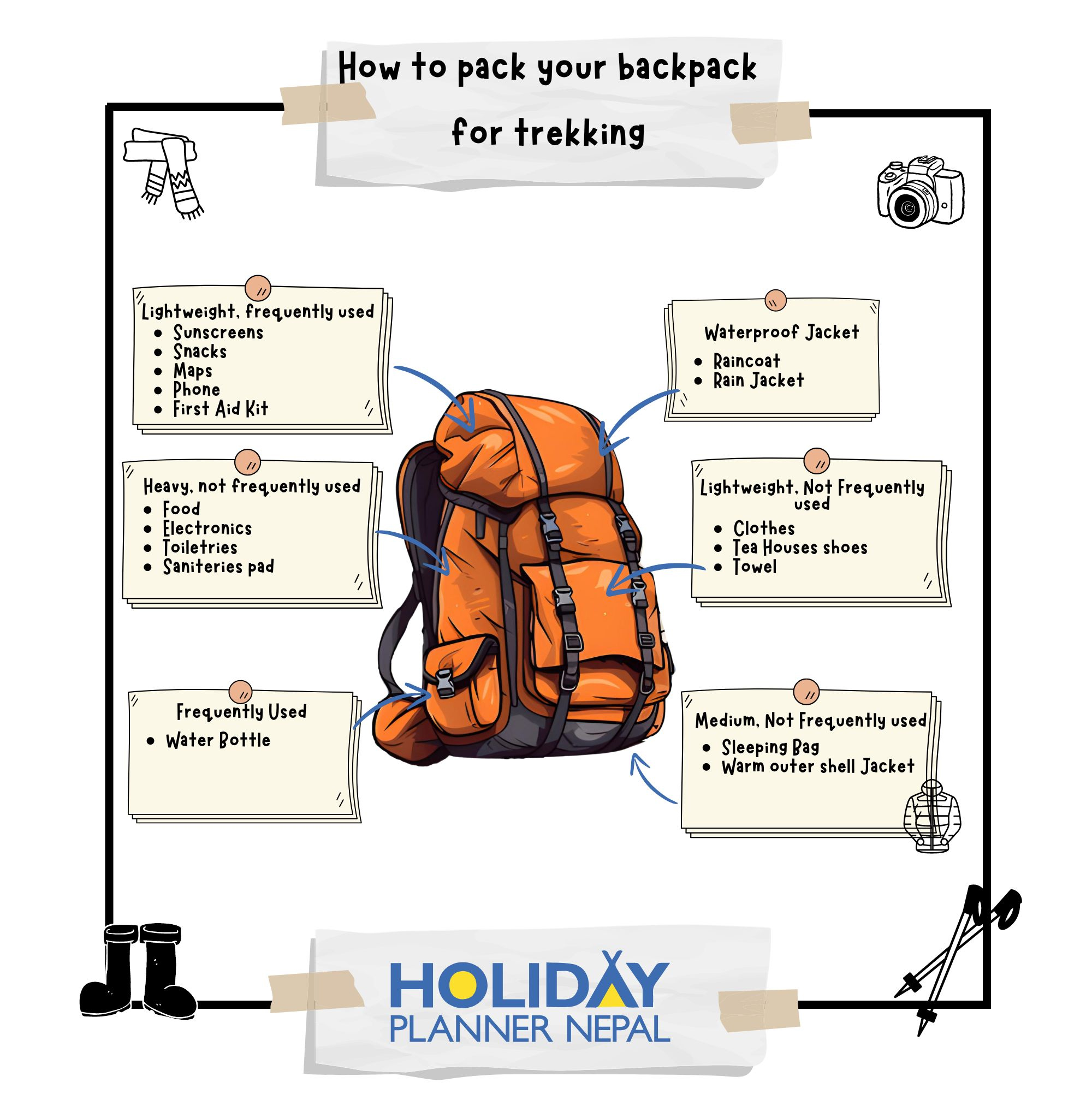
Note: Supplies and gear can be rented or purchased in Kathmandu. Once you are in Nepal, you can buy supplies and gear for hiking if you have spare time. Holiday Planner Nepal representatives will assist you in purchasing the equipment. Thamel a tourist hub, offers a wide range of trekking equipment at affordable prices. Don't wear short clothes inside the monasteries and religious places.
Advantages of booking Trek with Holiday Tours Nepal.
- We provide private car transportation services for the collection and delivery of passengers to and from specified locations on both international and domestic flights.
- We provide first-aid kits and first-aid services.
- Holiday Tours Nepal provides a range of essential items for travelers, including sleeping bags, down coats, T-shirts, caps, duffel bags, and city and hiking route maps, as required.
- We organize rescue and evacuation services as well which have to be paid for by the client or the travel insurance of the client.
- We provide an oximeter to monitor one's pulse, oxygen saturation, and heart rate daily. This practice proves to be very valuable in assessing symptoms related to Altitude Mountain Sickness (AMS). This measure aids in ensuring that your voyage is entrusted to the most secure and reliable individuals.
- Holiday Tours Nepal offers SIM cards to all its guests, ensuring seamless connection throughout their journey in Nepal. The client is responsible for covering the costs associated with the data pack and the activation charge for the SIM card.
- Fresh and seasonal fruits are provided after dinner and cookies are provided at tea/coffee time.
Conclusion
The Manaslu Circuit with Larke La Pass is one of Nepal’s most rewarding trekking adventures—an unforgettable blend of raw Himalayan wilderness, ancient Tibetan-influenced culture, and dramatic high-altitude landscapes. From peaceful river valleys and remote stone villages to the exhilarating challenge of crossing the 5,160m Larke La Pass, this trek showcases everything that makes Nepal a world-class trekking destination. Whether you’re seeking solitude, cultural depth, or unspoiled mountain beauty, the Manaslu region offers a transformative experience that remains as authentic as it is breathtaking.
If you’re dreaming of a trek that balances adventure, remoteness, and cultural richness, the Manaslu Circuit is the trail that delivers beyond expectations.
Ready to Start Your Manaslu Journey?
Contact Holiday Tours Nepal today to plan your fully organized trek with expert guides, reliable logistics, and personalized service for a safe and unforgettable experience.


 4.9(50 reviews)
 4.9(57 reviews)